I did not set out to test packing cubes for a year. I bought the BAGAIL 8-set the night before flying to Lisbon because my old system, which was basically shoving everything into gallon Ziploc bags, had finally humiliated me enough. The price was under twenty dollars. My expectations were exactly that low. That was November 2024. By the time I am writing this, those same eight cubes have been through 38 flights, two international trips, four domestic weekend runs, and somewhere between thirty and forty washing machine cycles. The zippers are still working. I want to be precise about what that means and what it does not mean.
This is the long-term review. Not the unboxing take, not the first-trip impression. If you want to know how the BAGAIL cubes hold up after real use across a full year of carry-on-only travel, this is the article. If you want to know whether they are the only packing cubes you will ever need, the honest answer is more complicated.
Quick Verdict
Durable enough for a year of weekly carry-on travel, good enough at compression to replace Ziploc bags entirely, and priced so low that the math works even if you replace them every two years. Not an Eagle Creek. Not trying to be.
Amazon Check Today's Price →Still searching for a packing system that doesn't collapse after three trips?
The BAGAIL 8-set is under $20 on Amazon and has over 42,000 reviews. It is the most-reviewed packing cube set I have found at any price. Check today's price and see which color sets are in stock.
Amazon Check Today's Price on Amazon →How I Have Used These Cubes Over 14 Months
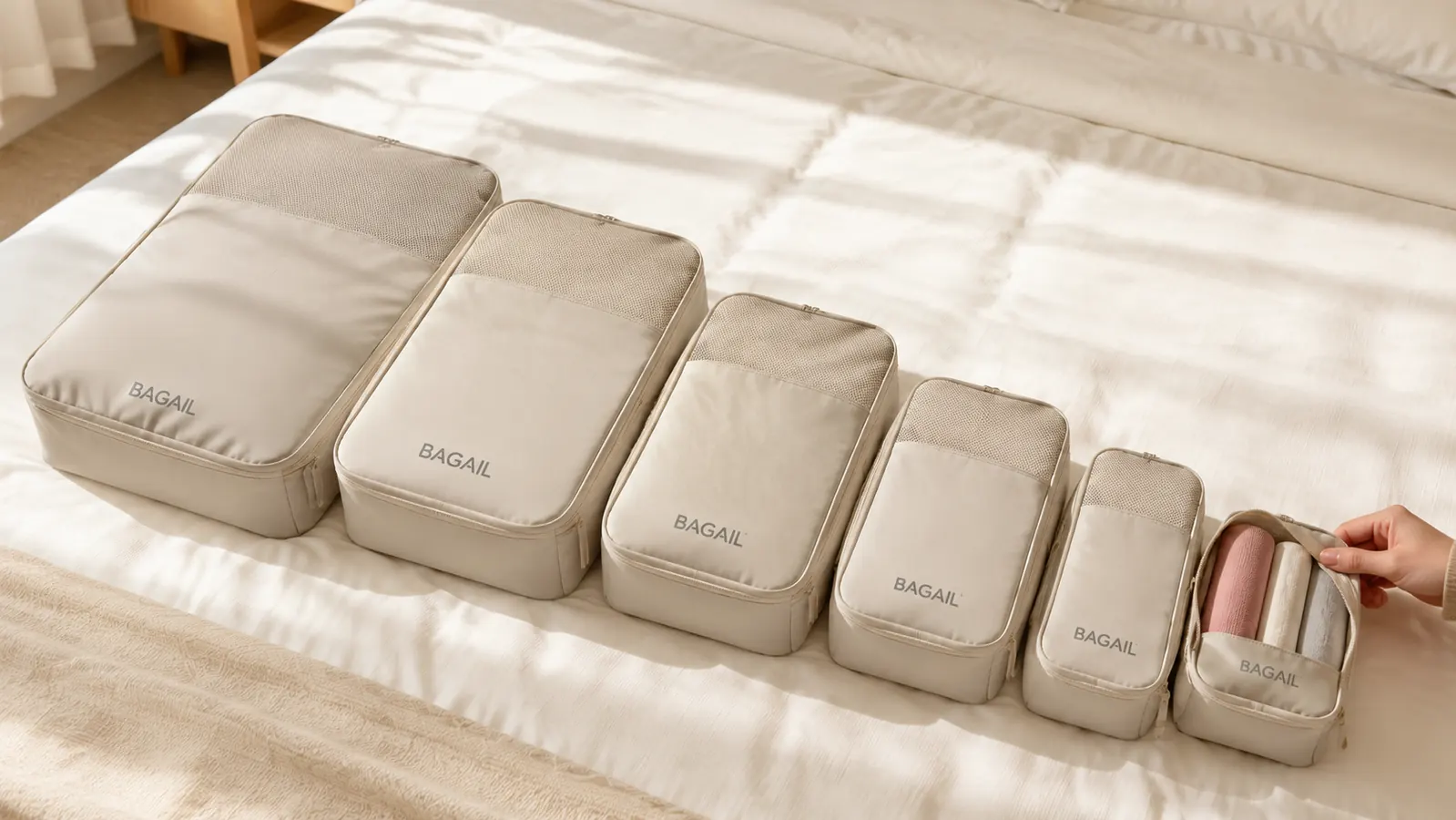
My carry-on is a Travelpro Maxlite 5, 21-inch. It is not a large bag. That constraint is what drives everything about how I pack, and it is what makes packing cubes either a tool or just extra weight. The BAGAIL set comes with eight pieces: two large (XL and L), two medium, two small, and two slim. I use all eight regularly, but not always in the same configuration.
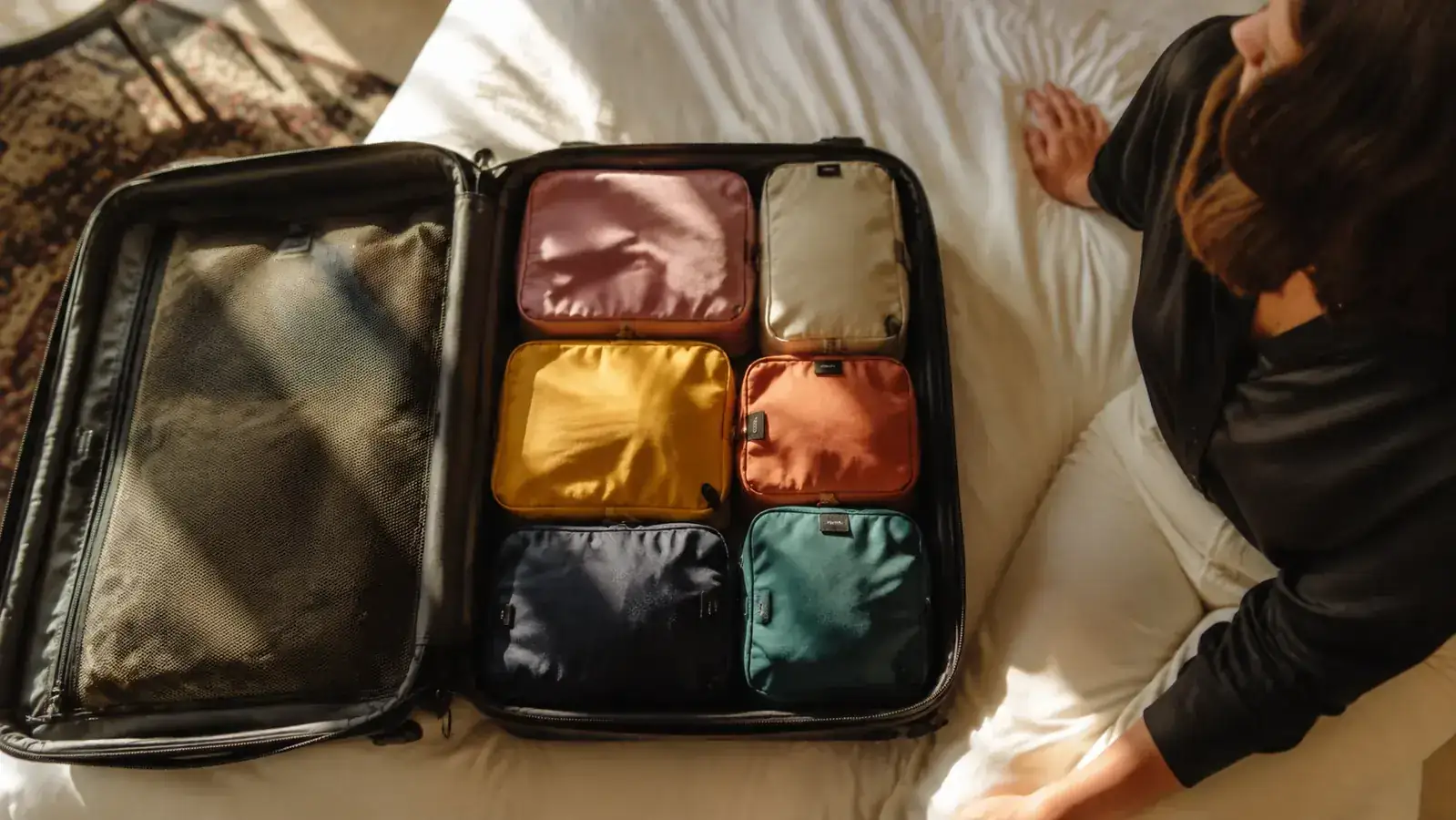
For a four-day trip, I typically run two mediums for tops and bottoms, one small for socks and underwear, one slim for the things I need fast at security (charging cables, a small power bank, my lip balm and hand cream). The large cubes I save for longer trips where I need to pack a full seven days into the same bag. The XL cube, when stuffed with rolled tee shirts, takes up roughly the full width of the Maxlite's main compartment. It sits in first, then everything else layers on top.
I have also used the slim cubes as a toiletry separator inside my dopp kit slot and as a flat organizer in the personal item backpack I carry under the seat. That second use has been a genuine quality-of-life improvement at security. Everything that needs to come out of the bag goes in one slim cube. One pull, one tray, back in, done.
Fabric and Zipper: What 38 Flights Actually Does
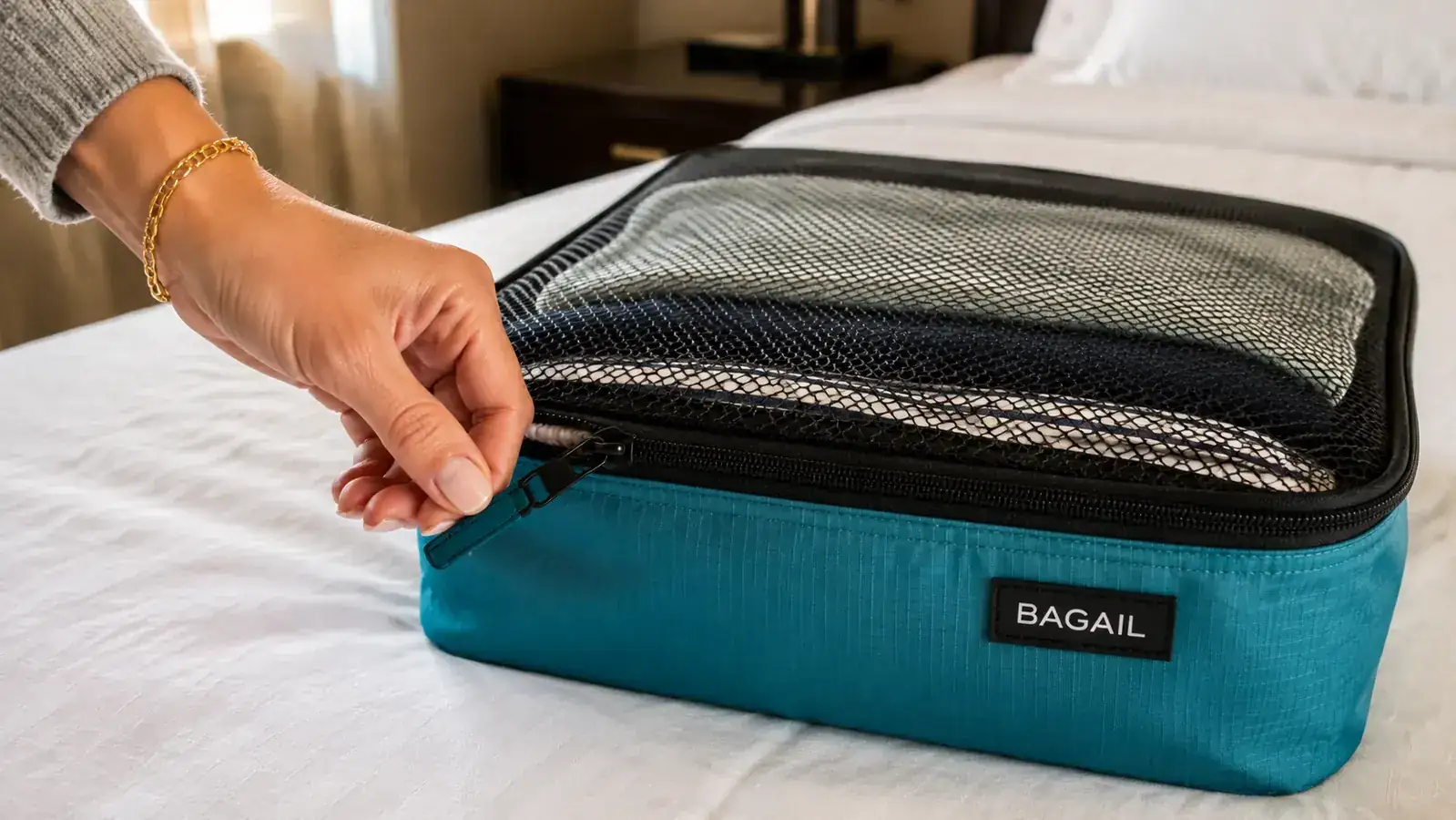
The BAGAIL cubes are made from a lightweight nylon ripstop with a mesh top panel. After 14 months, the nylon shows no fraying at the seams, no tearing at the zipper channel, and no visible wear along the panel edges. I was not gentle. These cubes have been stuffed into overhead bins sideways, squeezed between laptop bags, and used as a pillow armrest on a red-eye out of LAX. The fabric held.
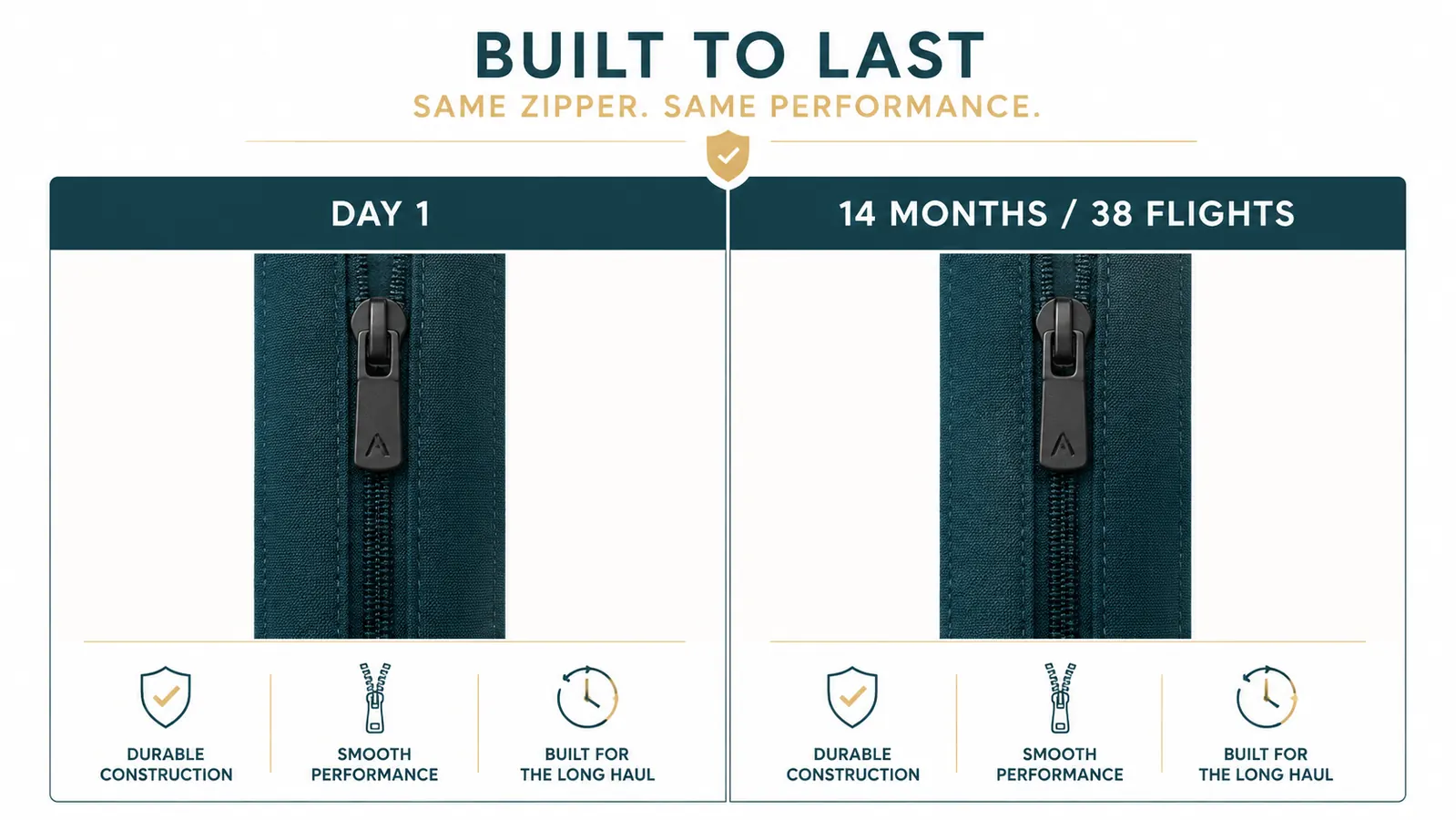
The zippers are where I expected the first failure. With cheap travel accessories, the zipper pull either breaks off or the teeth start separating, usually around the six-month mark. At 14 months, all eight cubes still zip cleanly. The pull tabs are a single loop of nylon webbing sewn through the puller head, not heat-fused plastic. That matters because heat-fused plastic pulls de-bond over time; sewn webbing does not. The one exception: on one of my mediums, the zipper runs slightly sticky when the cube is fully packed. Not broken, not jammed. Just sticky. I have not had to force it yet.
Washability deserves its own mention. The listing says hand wash, and I have ignored that instruction on every wash cycle. These cubes have been in cold machine wash at least 30 times. The color has not bled, the mesh has not shrunk, and the nylon has not pilled. I lay them flat to dry because I do not want to press my luck with a dryer, but the wash cycle itself has been a non-issue.
The one thing that surprised me most: the zippers. I expected them to go first. 14 months and 38 flights later, every zipper is still running clean.
Compression Performance: Honest Numbers
The BAGAIL cubes are not compression cubes in the Shacke Pak or Eagle Creek Specter sense. They do not have a double-zippered compression layer that squeezes air out of your clothes. What they do have is a firm nylon shell that holds its shape under pressure and lets you pack items tightly without them spring-unfolding inside the bag. If you use the ranger roll method with tee shirts, you can fit six rolled shirts in the large cube with room to spare. If you fold flat, you fit four. The difference is technique, not magic compression.
Where I notice the compression benefit is not at the cube level but at the bag level. When each category of item has its own cube, you can press the cubes against each other and fill the bag more efficiently than loose items ever allow. The Travelpro Maxlite has a flat main compartment. Loose clothing leaves air pockets at the corners. Cubes eliminate the air pockets by force. That is the actual mechanism at work, and it is effective.
For a week-long trip, here is what I can fit in the full eight-cube system inside a 21-inch carry-on: seven tee shirts, one lightweight merino sweater, four pairs of pants (two jeans, one linen trousers, one leggings), seven pairs of socks and underwear, one dress, one workout set, and a lightweight packable rain shell. The rain shell goes in the slim cube compressed flat. That is a real 7-day wardrobe for a mixed-climate trip, and the bag closes with zip to spare.
Size Guide: What Each Cube Is Actually Good For
Let me be specific because the sizing is where most people get confused with the BAGAIL 8-set. The XL measures roughly 17.5 x 12.6 x 3.5 inches. That is big enough to hold a full week of tops when rolled, but it takes up so much of a 21-inch carry-on that I only use it on trips of six nights or more. If I am packing for four days or less, the XL stays home and I use two mediums instead.
The medium cubes (around 13.8 x 9.8 x 3.5 inches) are my workhorses. One for tops, one for bottoms. That division has been my default system since month two and I have not changed it. The small cubes (around 11 x 6.7 x 3.5 inches) are my socks-and-underwear home and also where I keep my workout gear when I bring it. The slims are the wildcard. At roughly 13.8 x 9.8 x 1.4 inches, they are too flat for any clothing thicker than a tee shirt, but they are perfect for tech accessories, documents, and flat items that used to float loose and turn every bag dig into a frustrating archaeology project.
Pros
- Zippers held through 14 months and 38 flights with no failures
- Machine washable despite the hand-wash label (30+ cycles, no damage)
- 8-piece set covers every packing scenario from a weekend to a full week
- Slim cubes are the best tech-accessory organizer I have found at any price
- Mesh top panel makes contents visible without opening the cube
- Price is low enough that replacing one broken cube does not sting
Cons
- Not true compression cubes, no double-zip squeeze mechanism
- One of my mediums runs sticky when fully loaded (minor, not a failure)
- The nylon is thin enough that a sharp zipper edge on a neighboring bag could theoretically snag it
- XL cube is too large for anything under 22 inches if you want room for shoes and personal items
- Color selection varies by stock, you may not get the exact set shown
What I Compared Before Settling Here
Before the BAGAIL set, I had tried three other systems. The eBags Classic Slim 3-piece, which I used for two years and still own; the Shacke Pak 5-set compression cubes; and a no-name Amazon set whose brand I cannot recall because the logo fell off the zipper pull after four uses. The eBags are better constructed than the BAGAIL. The nylon is thicker, the zipper tape is wider, and they have survived more cycles. They are also sold as individual pieces, not in sets, and the price difference adds up. For a set equivalent to the BAGAIL 8-piece, you are spending three to four times more.
The Shacke Pak compression cubes genuinely compress. I measured a rolled tee shirt inside the Shacke versus the BAGAIL and the Shacke compressed it about 30 percent thinner. That matters for a 10-day trip where you need every cubic inch. It matters less for 4-day trips where the BAGAIL system is already efficient enough to close the bag without force. If you are packing for a long trip and every millimeter counts, the Shacke is worth the extra money. If you are packing for trips under a week, the BAGAIL system at a fifth of the price does the same practical job.
For the full head-to-head breakdown of the BAGAIL versus Eagle Creek's Pack-It Specter line, I have a separate comparison article that goes into the material differences in more detail. The short version: Eagle Creek is meaningfully better-built and about four times the price. Whether that gap is worth it depends entirely on how often you travel and what you are packing.
If you are curious about all the ways packing cubes generally change a carry-on-only packing system, the article on ten ways packing cubes changed my carry-on-only travel covers the system-level benefits beyond just the BAGAIL specifically.
Who These Cubes Are For
The BAGAIL 8-set is the right call if you are new to packing cubes and want a complete system without spending $80 to figure out whether you even like the method. It is also the right call if you travel 20-30 times a year and want to keep a spare set in your carry-on so one cube can be in the wash while you are packing for the next trip. The price makes that strategy viable. And it is the right call if you have been using Ziploc bags or rolling loose into the bag, because almost anything is an upgrade from that, and the BAGAIL system is a real, durable upgrade.
I have recommended this set to four people in the past year. Two of them were first-time carry-on converters. One was a retired teacher who flies several times a year to visit grandkids and thought packing cubes were "for influencers." She texted me after her first trip to say she had already ordered a second set to leave at her daughter's house. That is the audience this product serves well.
Who Should Skip These
If you are packing for cold-weather trips regularly, the BAGAIL cubes will frustrate you. Wool sweaters, down layers, and thick fleece do not compress inside a single-layer nylon cube. You will get them in, but the cube will be round and tight and you will spend time convincing the zipper to close. For cold-weather travel, you want a true compression cube, or you want to combine the BAGAIL system with a vacuum compression bag for the bulky items and use the BAGAIL cubes for everything else.
Also skip these if you are traveling with gear that has sharp edges: camera accessories, multi-tools (in checked bags), or hardware that could puncture the thin nylon. I have not had a puncture, but the material is not reinforced and a zipper tooth from a neighboring piece of gear at the wrong angle could catch it. The eBags or Eagle Creek fabric would handle that better.
If you have been putting off building a real packing system, the BAGAIL 8-set is a low-risk starting point with a year of proven durability behind it.
Over 42,000 reviews on Amazon. Rating of 4.6 out of 5. The price makes it easy to try the whole system without committing to a $100 experiment. Check today's price and color options.
Amazon Check Today's Price on Amazon →