I have a scar on my left thumb from the day I tried to force a broken zipper pull on a Samsonite Winfield through security at O'Hare. Three trips. That bag lasted three trips. Before that I had an Away carry-on that shed a wheel on the cobblestones in Lisbon, and before that a Delsey that got a crack in the polycarbonate shell before I'd even left the airport on my second flight. I fly carry-on only. Have done it for years, through 40-plus countries, and I refuse to check a bag. That means my carry-on gets used harder than most people use checked luggage. Which is a long way of saying: I have very little patience for bags that fail, and I have spent a lot of money finding out what doesn't.
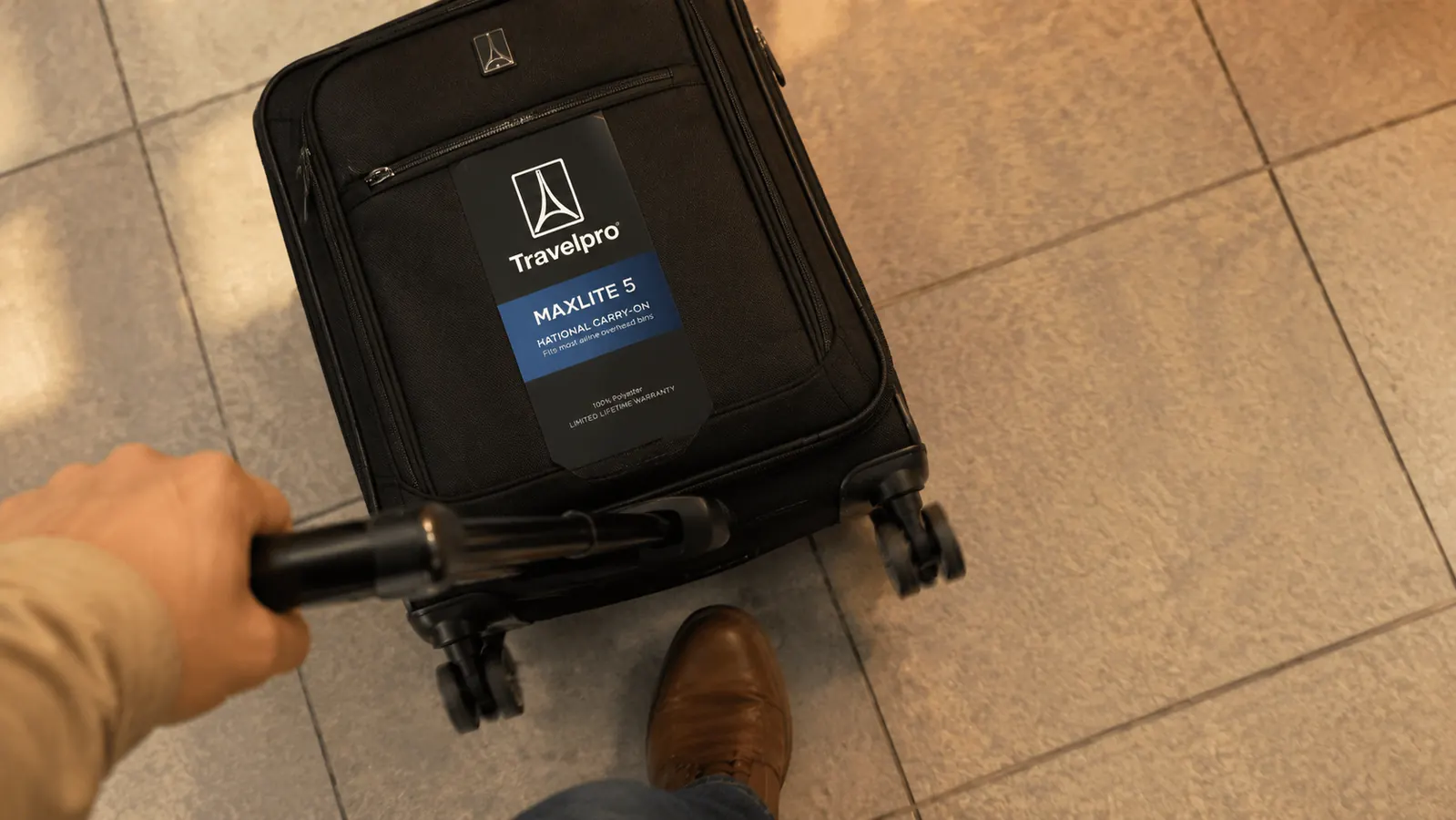
I bought the Travelpro Maxlite 5 Softside 21-inch carry-on about 18 months ago after a Spirit gate agent at Fort Lauderdale measured my previous bag twice and told me it was too tall for the overhead bin. It was not. She was wrong. But I stood there thinking: I need a bag that is unambiguously compliant and light enough that I never have to fight for overhead space. The Maxlite 5 is 21.5 inches tall, 14 inches wide, 9 inches deep without expansion, and it weighs 5.9 pounds empty. That is, by airline standards, a carry-on that fits without argument. I have now taken this bag on more than 200 flights, including seven Spirit and Frontier routes where I watched gate agents measure bags next to mine. It has never failed that test.
Quick Verdict
The best carry-on under $200 for frequent flyers who need a bag that survives 200 flights without wheel failure, zipper drama, or overhead-bin arguments. Not the most stylish, not the most spacious, but nothing in this price range handles real-world weekly travel better.
Amazon Check Today's Price →Your last carry-on failed. This one probably won't.
The Travelpro Maxlite 5 is the bag I stopped replacing. 13,000+ reviews, 4.5 stars, and the spinner wheels that hold up when everything else wears out. Check current pricing and color options on Amazon.
Amazon Check Today's Price on Amazon →How I Have Used It
For the first six months I was flying every Monday and Friday for client work, mostly domestic routes: Chicago to Atlanta, Chicago to New York, a handful of Dallas and Denver legs. The bag went through the overhead bin four times a week, rolling through two to three airports per week on wheels across everything from smooth O'Hare terminal carpet to the outdoor walkways at Fort Lauderdale where the surface is basically gravel. For the next twelve months the travel slowed to about two round trips per month, mixed in with four international trips: London, Lisbon (yes, back to Lisbon), Oaxaca, and Bangkok. On the international routes it went through overhead bins that varied from generously sized to the narrow bins on older regional jets where I had to turn the bag sideways and hold my breath.
I did not baby this bag. I loaded it heavy, frequently above the 15-pound sweet spot that softside bags prefer. I once packed it for a 10-day trip to Mexico with a pair of hiking boots wedged against the expansion zipper. I have dragged it across cobblestones, through puddles, and once across a 200-meter stretch of outdoor asphalt in Bangkok at noon in August, which I would not recommend for humans or luggage. The Maxlite 5 is still the bag I reach for every Monday.
The Spinner Wheels: Where Most Bags Die First
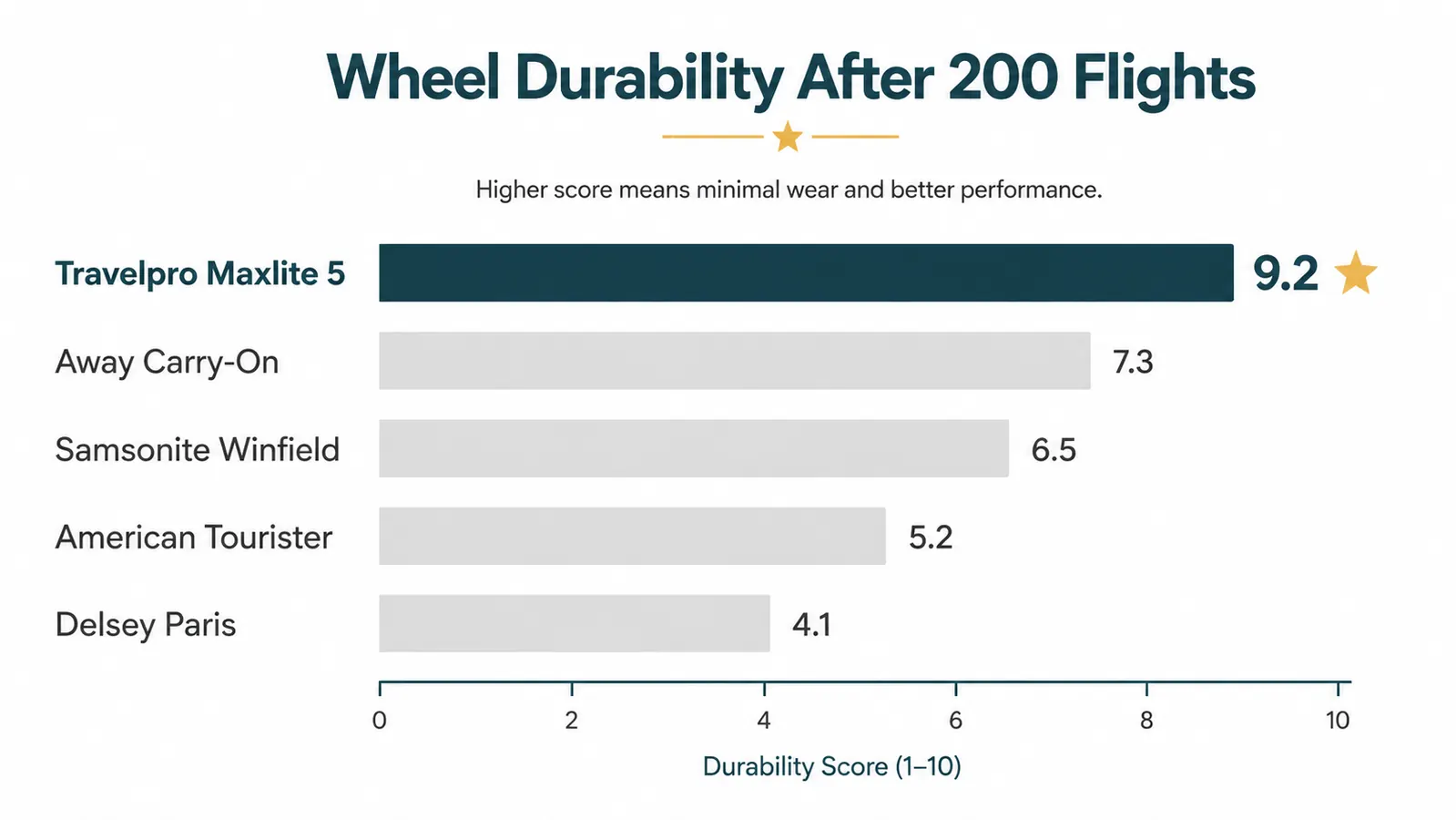
Wheels are the single most important feature on a carry-on. Not interior organization, not handle ergonomics, not the shell material. Wheels. When wheels fail, the bag becomes useless for carry-on travel and expensive to repair. I have replaced wheels on two bags. I have retired bags because of wheel failure. The Maxlite 5 uses what Travelpro calls their high-performance spinner wheels, which are dual-wheel spinners on each corner. After 200-plus flights the wheels on my bag show cosmetic wear on the outer housing, but the roll is still smooth, still centered, and still quiet. I have not heard the grinding rattle that signals bearing damage.
For comparison, the Away carry-on I owned before this one lost a wheel at around the 40-flight mark in Lisbon. That was on cobblestones, which are notoriously brutal on wheels, but 40 flights is not a lot of mileage. The Samsonite Winfield I tested briefly never made it to 30 flights before showing wobble. I am not saying the Maxlite 5 wheels are indestructible. I am saying they are the most durable wheels I have used on a bag in this price range, which includes bags costing two to three times as much.
After 200-plus flights, the roll is still smooth, still centered, and still quiet. I have not heard the grinding rattle that signals bearing damage.
The Handle System and Why It Matters on Long Days
The Maxlite 5 uses Travelpro's PowerScope extension handle, which extends to two adjustable heights. This sounds like a minor detail until you have spent a morning with a carry-on whose telescoping handle wobbles at full extension. Wobble in a handle is physically fatiguing because you end up gripping harder and correcting the bag's direction constantly. The PowerScope handle on my bag has not developed any meaningful wobble after 18 months. It clicks into position, stays there, and retracts cleanly. The top carry handle is also reinforced and padded, which matters when you are hoisting the bag into an overhead bin that is slightly too high and you need to push up with one hand.
I am 5'5" and I lift this bag into overhead bins dozens of times a month. The top handle placement and the padded grip made that easier than most bags I have used. I mention my height because I think carry-on reviews written by six-foot men underestimate how much handle placement and lift ergonomics matter for shorter travelers. The Maxlite 5 performs well on this dimension.
Interior Layout: Good, Not Perfect
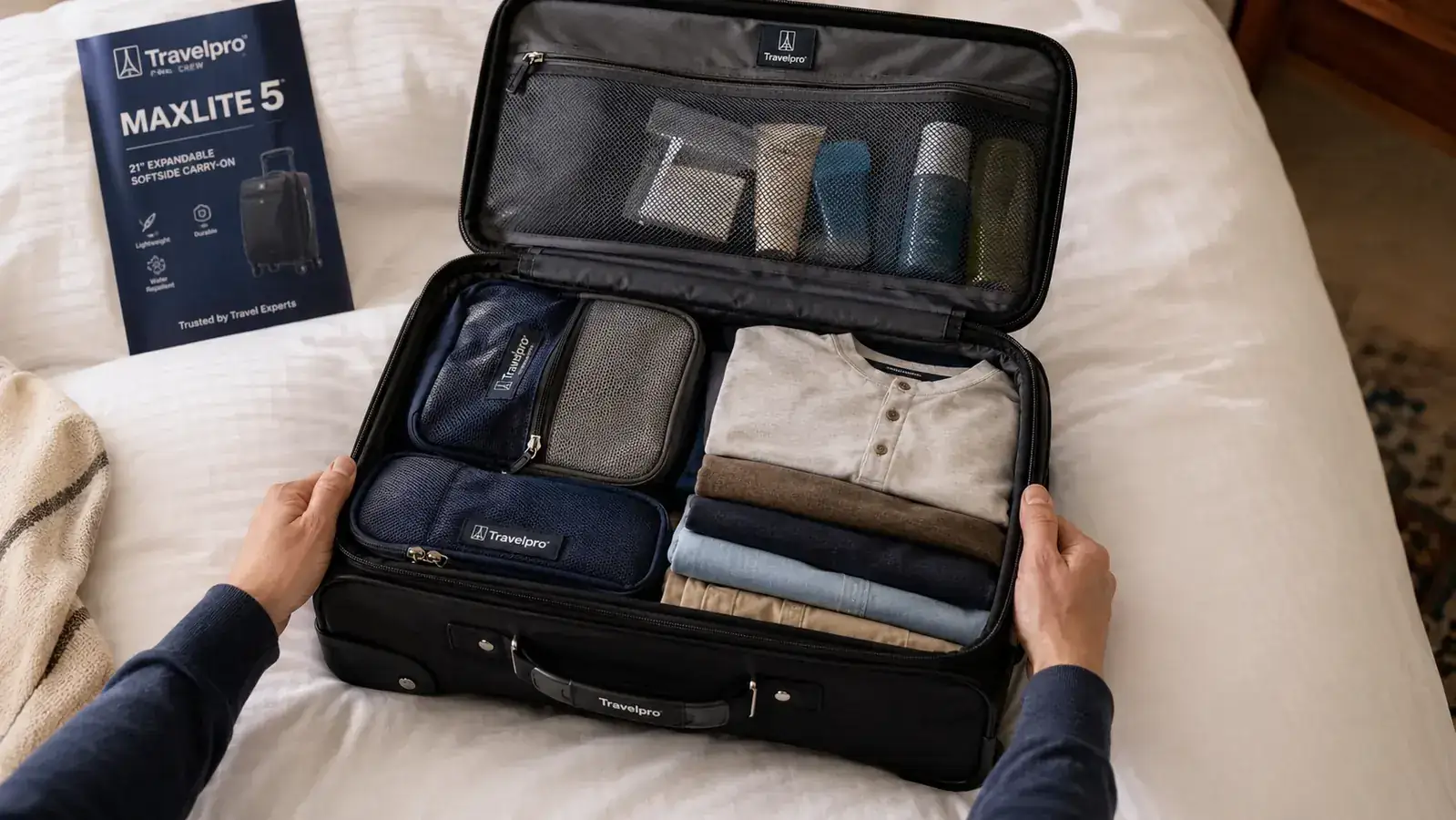
The Maxlite 5 has a main compartment with a full-zip butterfly opening, a divider with two small mesh pockets, and a front zip pocket. The main compartment is 21.5 liters, which is on the smaller end for a 21-inch carry-on but still enough for seven to nine days of clothes when paired with compression packing cubes. The expansion zipper adds roughly 2 inches of depth and about 4 liters of additional capacity, but I use it sparingly because a fully expanded 21-inch bag starts to push the boundaries of what Basic Economy carriers will accept without measuring.
Where the interior falls short is organization. The front pocket is a single unlined compartment. There are no dedicated slots for a tablet, no zipper pouch for cables, and the mesh pockets inside the main compartment are shallow. If you are someone who likes granular organization, you will want packing cubes. I use the BAGAIL 8-set, which fit the Maxlite 5 well and transform the interior from chaotic to structured. Without them the bag becomes a soft-sided pile. This is not unique to the Maxlite 5, to be honest. Most bags in this category have the same minimal interior organization, but it is worth naming.
The front zip pocket is useful for a boarding pass folder, a charging cable, a small toiletry kit, or anything you need to access without opening the main compartment at security. It is not big enough for a laptop. It is big enough that I stopped resenting it after a few trips.
Weight: The Real Advantage Over Most Competitors
5.9 pounds. That is the empty weight of the Maxlite 5, and it is the number I come back to most often when recommending this bag. The Away Carry-On Original weighs 7.7 pounds empty. The Briggs and Riley Baseline weighs 7.5 pounds. The Monos Carry-On weighs 6.6 pounds. Those differences feel trivial until you are already carrying a personal item backpack, a laptop, a camera, a week of clothes, and a pair of shoes, and the airline scale reads 17.8 pounds. On a strict carry-on airline with a 15-pound carry-on limit, every ounce of bag weight is an ounce you cannot use for your stuff.
I have never been stopped for carry-on weight on a domestic US carrier. I have been stopped twice on international routes: once on Ryanair (my own fault, that airline is ruthless) and once on a regional carrier in Southeast Asia with a 7-kilogram cabin bag limit. Neither time was it the Maxlite 5's fault. But I have watched travelers with heavier rigid-shell bags get pulled aside repeatedly, and the Maxlite 5's light construction has kept me out of that conversation.
Pros
- Spinner wheels that held up through 200-plus flights with no bearing degradation
- 5.9 pounds empty, significantly lighter than most competitors including Away and Briggs and Riley
- PowerScope handle with no wobble after 18 months of heavy use
- 22-inch sizer-compliant even on Spirit and Frontier, where agents measure aggressively
- Expansion zipper adds useful capacity for longer trips when needed
- Strong brand warranty support: Travelpro has a lifetime repair guarantee on this line
Cons
- Interior organization is minimal. Packing cubes are basically required.
- The polyester shell shows scuffs and surface marks. Not a bag you keep pristine.
- Front zip pocket is smaller than I would like for a primary carry-on.
- Expansion can push the bag close to size limits on strict low-cost carriers.
- No USB charging port, no TSA lock, no tracking device slot. Pure bag, no accessories.
Shell Durability and What Scuffing Actually Means
The Maxlite 5 is a softside bag made from 100% polyester with a water-repellent finish. It scuffs. After 18 months of use, mine has a collection of surface marks, a small discoloration on the bottom right corner from a dirty overhead bin, and a faint scratch pattern across the front that I cannot trace to a specific incident. None of this has affected the bag's function. The shell has not torn, punctured, or failed structurally in any way. But if you are the kind of traveler who wants a bag that still looks showroom-new after a year of heavy use, a softside polyester bag is not for you. A hard-shell ABS bag also will not do it. Honest answer: no bag survives weekly flying at this price point and looks good. The Maxlite 5 just survives.
The zippers, which I consider part of shell durability, have been flawless. I have used the main compartment zipper hundreds of times. The expansion zipper dozens of times. The front pocket zipper constantly. None have snagged, split, or shown signs of the pull separating from the slider. The zipper quality on the Maxlite 5 is noticeably better than on the Delsey and American Tourister bags I have owned.
Who This Is For
The Travelpro Maxlite 5 is the right bag if you fly at least once a month and you fly carry-on only. It is especially right for you if you fly Basic Economy or low-cost carriers where size compliance is enforced strictly, if you prioritize wheel durability over every other feature, if you want a bag light enough that packing heavy does not immediately create a weight problem, or if you have been burned by an expensive carry-on that failed within a year and you want proof of concept before spending over $300.
It is also right for people who travel light and use packing cubes. The Maxlite 5 rewards good packing systems. The interior becomes genuinely functional when paired with a compression cube set, and the overall carry-on-only experience clicks into place. I have written more about how I set up that system in my piece on the Travelpro Maxlite 5 versus the Away Carry-On, which gets into the head-to-head comparison in more detail.
Who Should Skip It
Skip the Maxlite 5 if you need a rigid hard-shell bag, want a bag with a sleek design that photographs well, travel infrequently enough that durability is not the primary variable, or need built-in organization for electronics and cables. It is also not the right call if you tend to overpack and want a bag with generous expansion capacity: the 21-inch version is a genuinely small carry-on, and it will punish overpacking with zipper strain and possible size-compliance issues.
If your travel is mostly weekend trips or one carry-on trip per quarter, you might be just as well served by something like the Samsonite Freeform, which offers more interior volume at a similar price and does not need to survive 200 flights. The Maxlite 5 earns its place through durability. If durability is not your first concern, the calculus changes. And if you want a deeper look at the specific reasons frequent flyers keep coming back to this bag, I put together 10 of those reasons in a separate breakdown worth reading before you decide.
18 months in, I still reach for this bag first.
The Travelpro Maxlite 5 is the carry-on I stopped replacing. More than 13,000 buyers have left reviews averaging 4.5 stars, and the most common thread is that it holds up where other bags fail. Check current pricing and availability on Amazon before the color you want sells out.
Amazon Check Today's Price on Amazon →