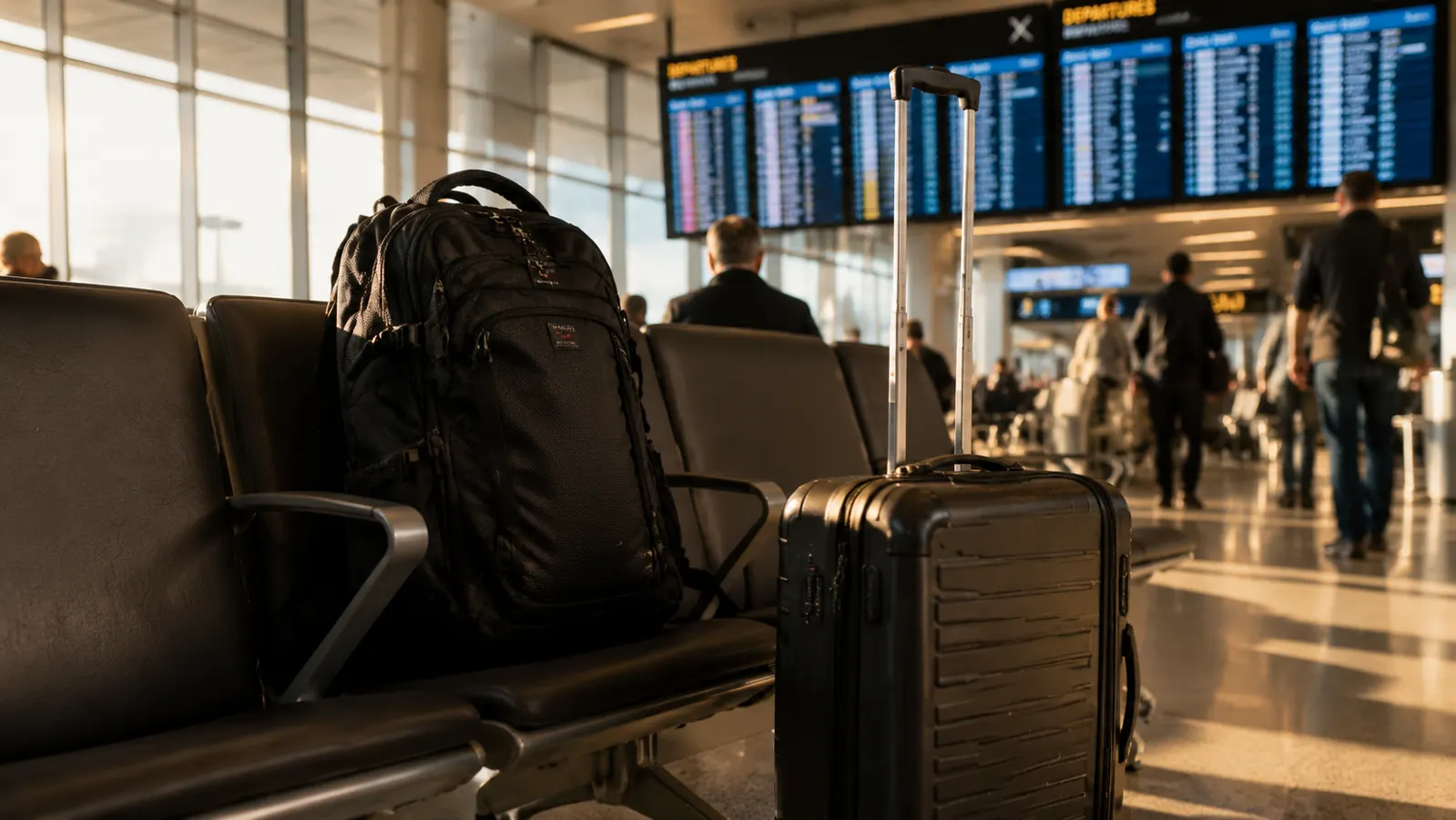
Eighteen months ago, United started enforcing its basic-economy personal-item-only rule at the gate in Denver. I had my Travelpro Maxlite 5 in the overhead bin on that flight, but the trip back was a basic-economy ticket and I needed something that would actually slide under the seat in front of me without a gate agent waving me over. My old drawstring bag was not going to cut it. I needed a structured bag, something that could hold a 15-inch MacBook Pro, a change of clothes, my toiletry bag, and my noise-canceling headphones, and still pass the Spirit-tier sizer test without argument.
The coofay Travel Backpack came up in a thread I trust. Under $25, airline-approved dimensions (17 x 12 x 6 inches when stuffed), waterproof-coated nylon, a dedicated laptop sleeve, and a side water-bottle pocket big enough for a 32 oz Nalgene. I ordered one on a Thursday, flew with it that Sunday on Delta from ATL to LAX, and did not stop using it until I finally sat down to write this. Forty-three flights. Three carriers. One bag.
Quick Verdict
A legitimate personal-item workhorse at a price that makes you feel almost guilty. Not perfect, but nothing at $24 is. The zippers are the single thing I watch.
Amazon Check Today's Price →Stop paying $70 for a gate-check fee on a bag you could fit under the seat
The coofay travel backpack fits United, Delta, and Southwest personal-item dimensions. 4.6 stars across 10,000+ reviews. Check today's price before your next trip.
Amazon Check Today's Price on Amazon →How I Have Used It: 18 Months as My Under-Seat Companion
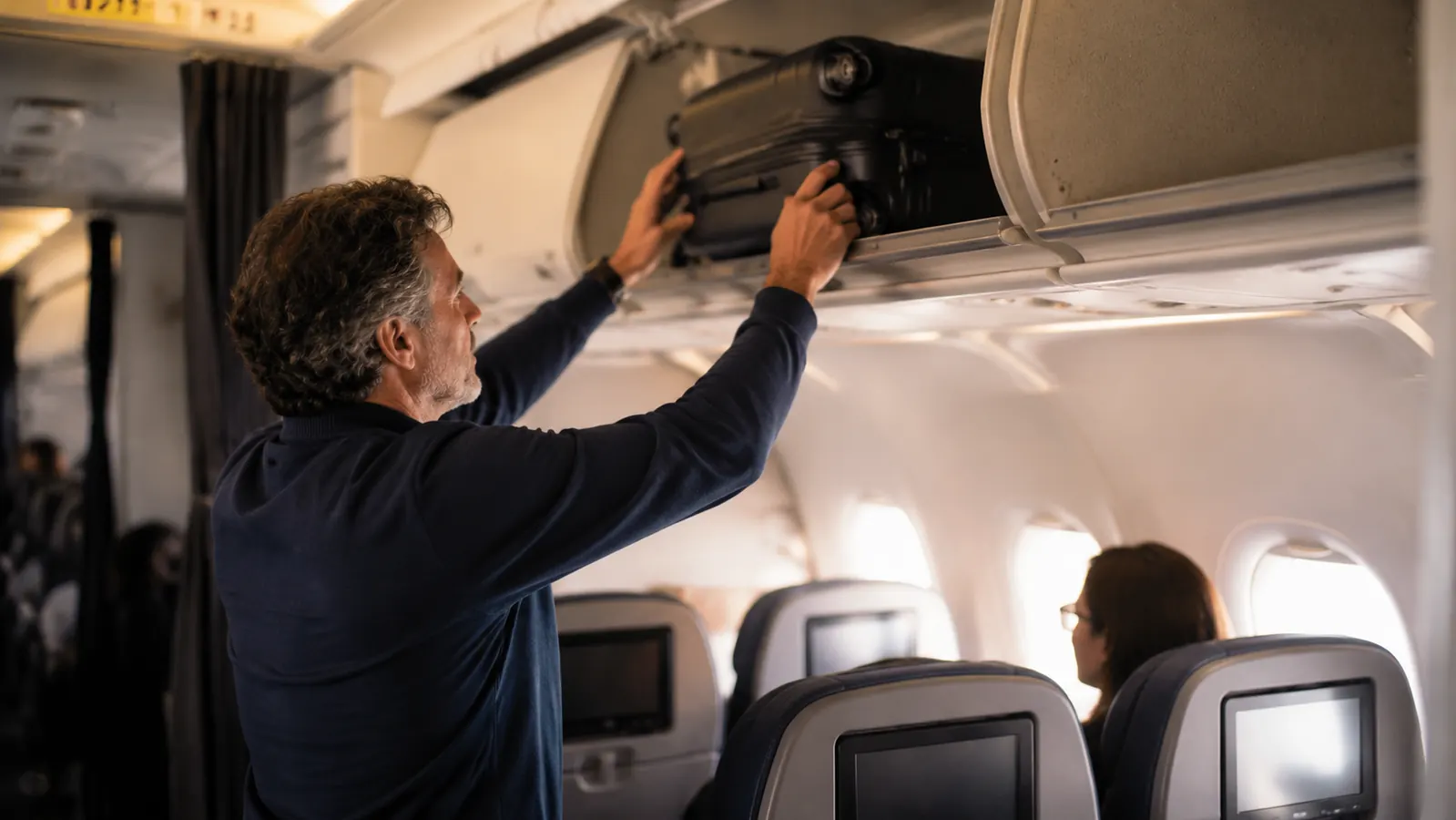
My standard setup for the past year and a half is the Travelpro Maxlite 5 in the overhead bin and the coofay under the seat. The coofay rides in the overhead on shorter hops where I get on early enough to claim bin space, but its real job is the under-seat slot. On a 737, that slot is 18 inches wide and about 10 inches tall. The coofay, even when I have loaded it to its absolute limit, slides in without requiring me to lift and stuff. That matters at 6 a.m. before I have had coffee.
The trips have ranged from two-day business runs from SEA to ORD to a two-week swing through Portugal and Spain where the coofay was my only bag, period. I packed a four-day wardrobe in BAGAIL compression cubes, a 15-inch laptop, a Sony WH-1000XM5 headphone case, a Dopp kit, and my camera lens pouch. It fit. Barely, on the Spain trip. But it fit.
I have been gate-checked twice on regional CRJs where the overhead bins are too small for anything larger than a hat. Both times the coofay came back unharmed. Both times it was not tagged with a claim ticket because the gate agent treated it as a soft bag, not luggage. That is actually a meaningful benefit: because this bag collapses when empty, ramp handlers treat it like a soft personal item, not like a bag worth kicking.
What Goes Inside: Capacity Breakdown
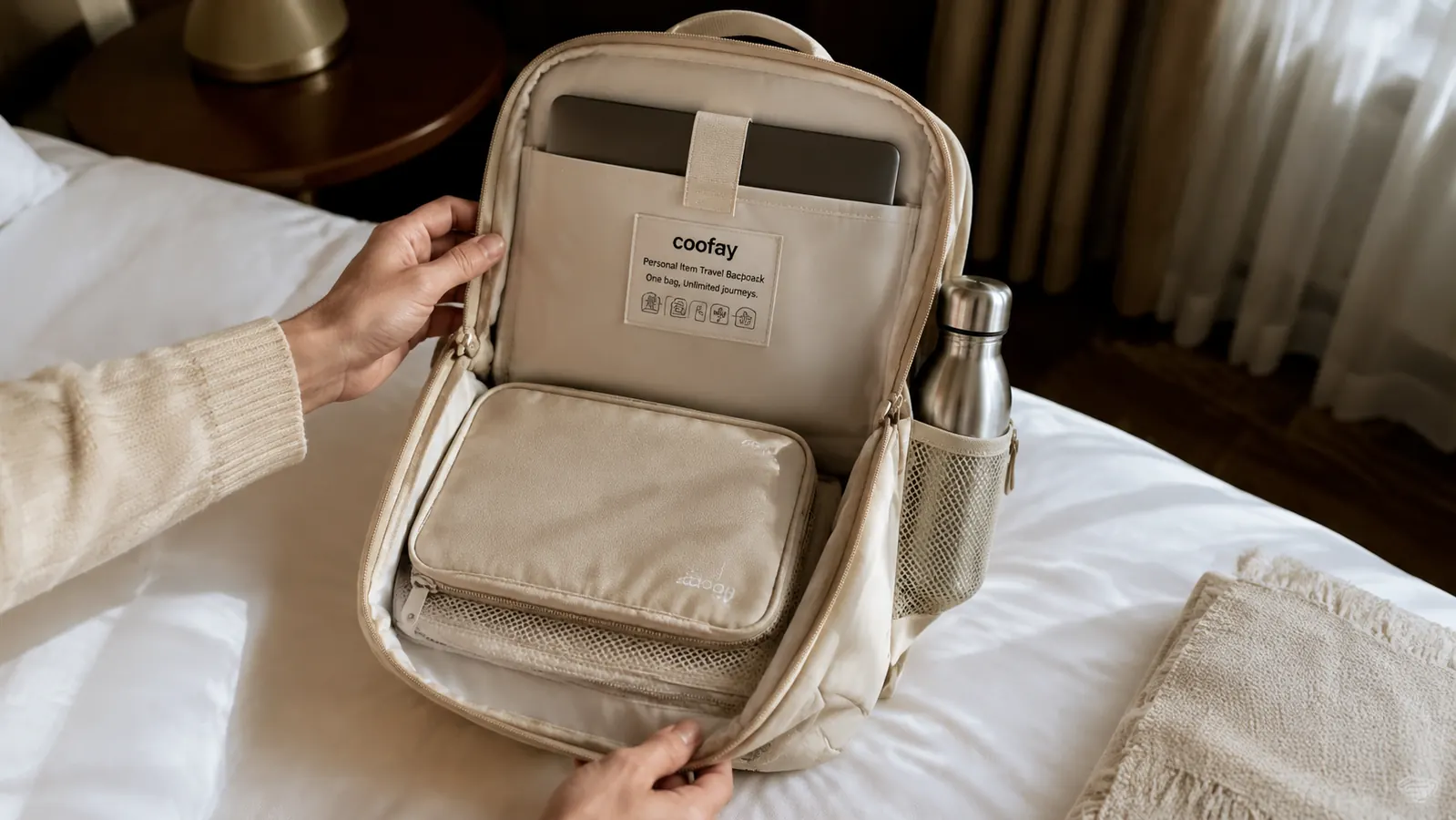
The main compartment measures roughly 15 x 11 x 5 inches when the bag is fully expanded. It is not a deep cave. Packing order matters. I put the BAGAIL compression cube against the back panel first, then the headphone case, then a stuffsack with an emergency layer. The organizational zipper panel at the front of the main compartment is where keys, a passport, a charger, and a small power bank live. It has four separate slip pockets and a small zip pouch. Not fancy. Functional.
The laptop sleeve sits in a dedicated panel at the back, padded on both sides with thin foam. My 15-inch MacBook Pro fits without forcing it. The sleeve is not padded enough to protect against a hard drop, so I keep my laptop in a thin Tomtoc sleeve inside the coofay sleeve for that extra layer. If you are carrying a 16-inch laptop, measure it first. The sleeve is snug on a 15-inch.
The side water-bottle pocket is the detail I mention every time someone asks about this bag. It stretches to fit a 32 oz Nalgene, a 24 oz Hydro Flask, or any tall insulated bottle. Most backpacks in this price range have a shallow mesh sleeve that barely holds a 20 oz bottle. The coofay pocket is deep enough that the bottle does not bounce out during overhead storage. I have not had a bottle fall out in 43 flights. That is not nothing.
Durability After 18 Months: What Wore, What Held
The nylon shell has held up better than I expected. The waterproof coating has not peeled or cracked. In three separate rainstorms (Lisbon, Seattle, and a very aggressive puddle outside O'Hare), the main compartment stayed dry. The bottom of the bag picked up scuffs from being placed on airport floors and under bus seats, but there is no structural damage, no fraying at the seams, and no bubbling at the coating seams.
The shoulder straps are the second thing I watch after the zippers. They are padded with a thin slab of foam inside a nylon sheath. After 18 months, the stitching where the left strap meets the back panel has started to show mild stress. Not fraying, not separating, just the thread flattening in a way that tells me it is being asked to work. I am watching it. If I were a larger person carrying heavier loads than my typical 18 lbs, I would be more concerned. At my load and my frame, it is holding.
The handle strap at the top of the bag is the pleasant surprise. It is a flat ribbon of nylon with a simple grip wrap, and it has not stretched, frayed, or stiffened. It is the part of the bag I grab when I am hauling it out from under the seat on short final, and it still feels like a new bag.
Zipper Watch: The One Area That Requires Attention
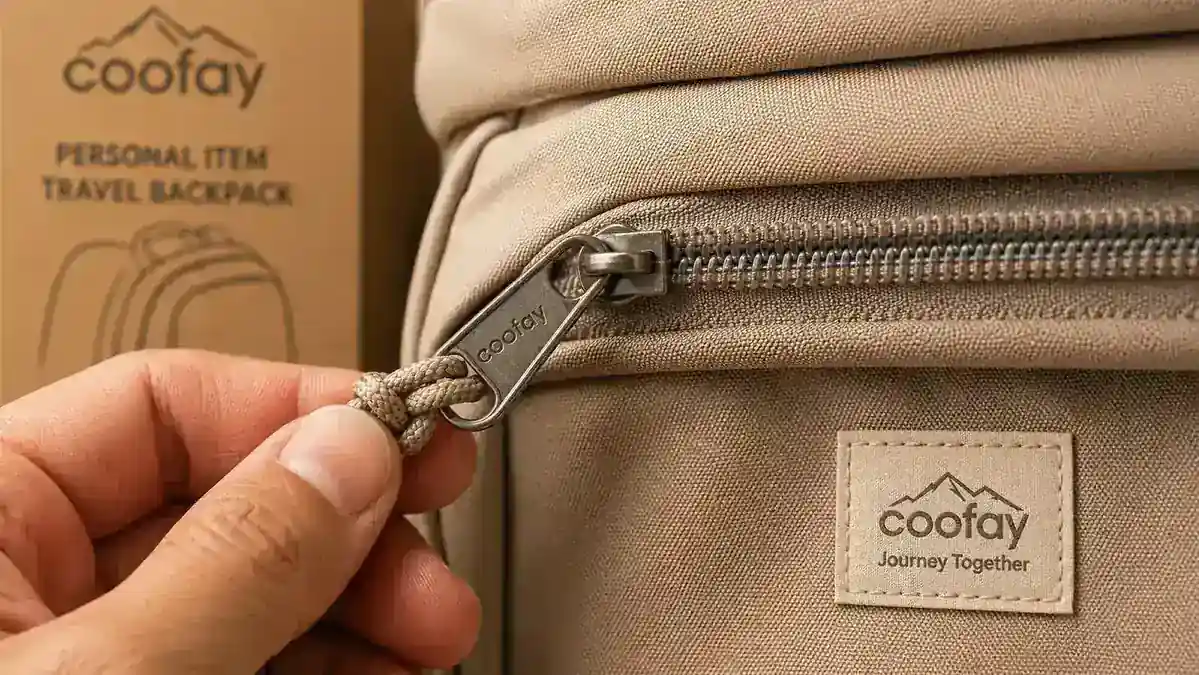
I want to be specific about the zippers because this is where budget bags usually fail first and where the coofay gives me the most pause after extended use. The main compartment zipper and the laptop compartment zipper have both been fine. They track smoothly, they do not skip teeth, and the pulls are substantial enough to grab without looking. Those two zippers have earned full marks.
The small front organizational zipper is a different story. By month eight, it started to feel slightly gritty when opening, as if tiny debris had worked into the teeth. I cleaned it with a soft brush and a small amount of zipper lubricant and it smoothed out, but I now clean it every two months as a routine. On a bag you are using twice a week, that is a reasonable maintenance expectation. On a bag you use twice a year, you probably would not notice. I am noting it because I use this bag hard.
The main zippers have earned full marks. The small front zipper needs a brush and some lubricant every couple of months. On a bag used 80 times a year, that is fair.
Airline Compliance: What Passed, What Was Questioned
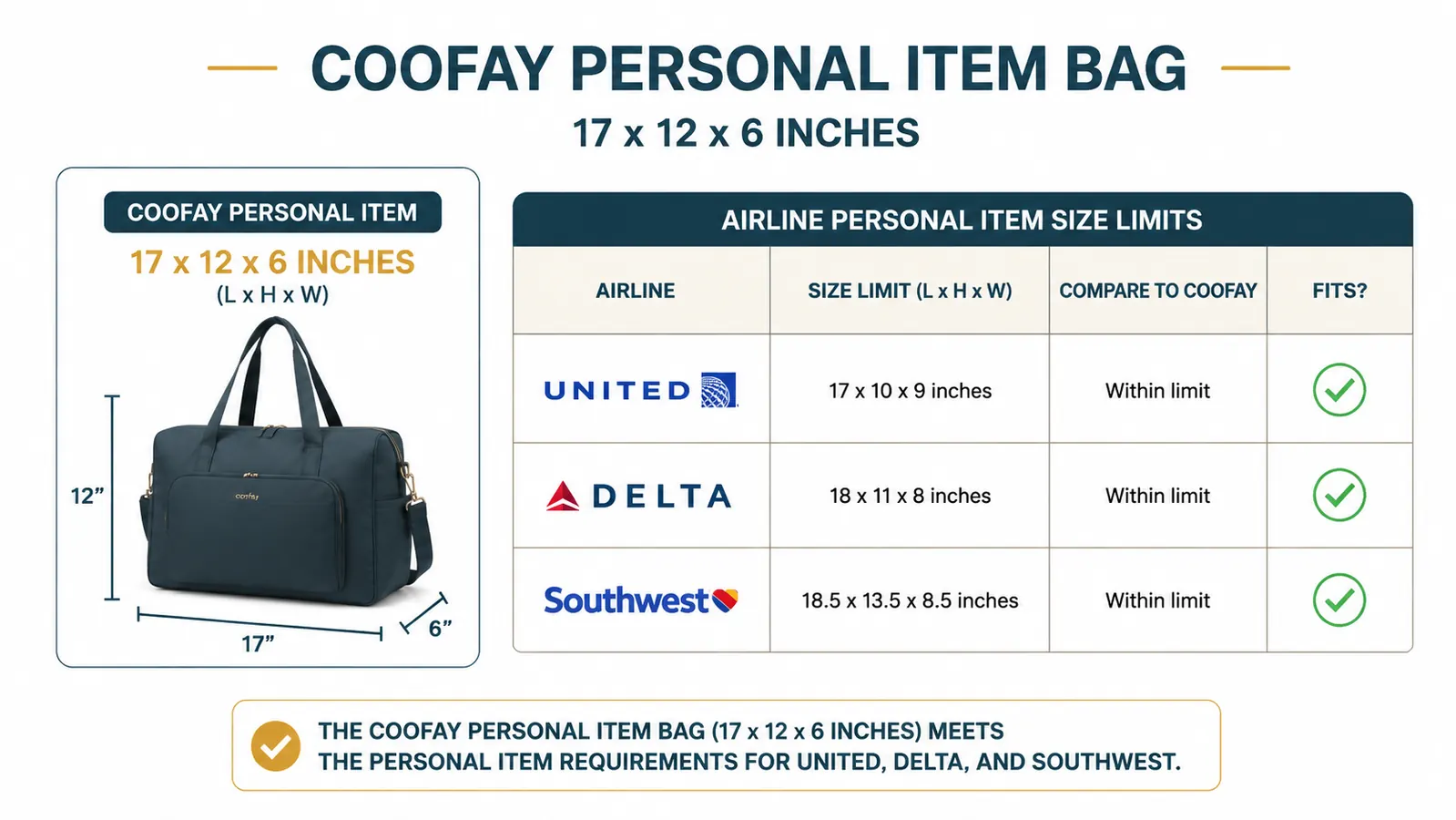
The coofay's listed dimensions are 17.5 x 12.2 x 6.3 inches. Most carriers allow a personal item up to 18 x 14 x 8 inches, though Spirit and Frontier are stricter at 18 x 14 x 8 with enforcement that varies wildly by gate agent and city. I have flown this bag on United, Delta, and Southwest without incident. I have never been measured, questioned, or asked to check it. Part of that is because the bag looks organized and compact at the gate, not bulging.
The one time I was nervous was a Spirit flight out of FLL where a gate agent was measuring everything. She held her sizer box up, looked at my coofay, looked at me, and waved me through without measuring. I think the soft-sided construction helped: it did not look like someone was trying to sneak a hardside carry-on past her. It looked like a backpack. Spirit's sizer is 18 x 14 x 8 inches. My fully loaded coofay was sitting at about 17.5 x 12 x 6.5. That is within compliance, but just barely with a Dopp kit and headphones inside.
What It Compares to at the Price Point
At $24, the coofay competes with the Matein travel backpack, the Inateck laptop backpack, and a handful of AmazonBasics-tier options. I bought a Matein 18 months before I found the coofay. The Matein lasted about nine months before the bottom panel seam started pulling apart, and the water-bottle pocket collapsed to the point where it could not hold a bottle upright. The coofay has outlasted that timeline already with no equivalent failure. That is not a scientific comparison, but it is the honest one.
The bags that beat the coofay are in a different price tier. The Osprey Daylite is a better bag in almost every dimension but costs $75 and is more of a daypack than a personal-item travel bag. The Peak Design Travel Backpack starts at $299 and is built for a different customer. At the $24-$40 price point, I have not found anything that beats the coofay on the combination of volume, organization, water-bottle pocket depth, and durability.
Pros
- Slides under the seat on every major US carrier, including regional CRJs when gate-checked as a soft bag
- Side water-bottle pocket fits a 32 oz Nalgene and keeps it upright during overhead storage
- Waterproof coating has not peeled or cracked after 18 months and three rain events
- Main and laptop zipper quality is well above the price point
- Handles a 15-inch laptop without requiring a separate sleeve, though one helps
- Collapses flat when empty, so it stows in a suitcase for outbound trips where you want it available for the return
Cons
- Front organizational zipper needs periodic cleaning and lubricating under heavy use
- Shoulder strap stitching at the panel junction is showing stress at 18 months under moderate loads
- Laptop sleeve padding is minimal; a 16-inch laptop is a tight fit
- Back panel is flat with no ventilation channel, gets warm on longer carry sessions through terminals
- No external luggage pass-through sleeve for stacking on a roller
Who This Is For
You are the right customer for this bag if you fly a few times a month, typically pair it with a carry-on roller, and want a reliable personal item that does not cost as much as one checked bag fee. It is ideal for domestic trips of three to five days where the coofay handles your electronics, a change of clothes, and your toiletry bag while the Maxlite or your roller handles the rest. It works as a solo bag for weekend trips if you pack with compression cubes and leave the bulky shoes at home. It is also a very good work bag on non-travel days because it holds a laptop and a full day's worth of gear without advertising itself as a travel product.
Who Should Skip It
If you are flying international premium economy or business class on long-haul routes where your personal item stays in the overhead or in the seat pocket, the coofay's minimal back-panel padding and the lack of a luggage sleeve will frustrate you. It is also not the right bag if you carry a 16-inch laptop or larger and need the sleeve to handle it unprotected. And if you are the type of traveler who loads 30 lbs into a personal item and argues with gate agents, the strap stitching at the panel will not survive your use case. This is a working traveler's light-duty bag, not a mule.
A personal item bag that has survived 40 flights is rare at $24. Check whether it is still at that price before your next booking.
The coofay is rated 4.6 stars by more than 10,000 buyers. Fits under the seat on United, Delta, Southwest, and Spirit. Holds a 15-inch laptop, a 32 oz water bottle, and a full day of travel gear.
Amazon Check Today's Price on Amazon →