Let me give you the short answer first: if you fly carry-on only and want a personal item that slides under the seat without a second thought, the coofay travel backpack wins this comparison. It is not close on the one dimension that matters most at the gate. But that does not mean Beis loses completely, and I want to be fair about where the $178 weekend bag earns its price before I explain why I keep reaching for the $24 one.
I came to this comparison because of a specific frustration. I had been carrying a structured tote as my personal item for about a year, the kind of bag that looks great on Instagram and then causes actual problems on a Spirit A320. The under-seat compartment on that plane is ruthless. I started researching alternatives in the personal item category and kept running into the same two names at opposite ends of the price spectrum: Beis, which has become the recognizable brand in the premium travel bag space, and coofay, which kept showing up with 4.6 stars across 10,000-plus reviews despite looking like it costs what it actually costs.
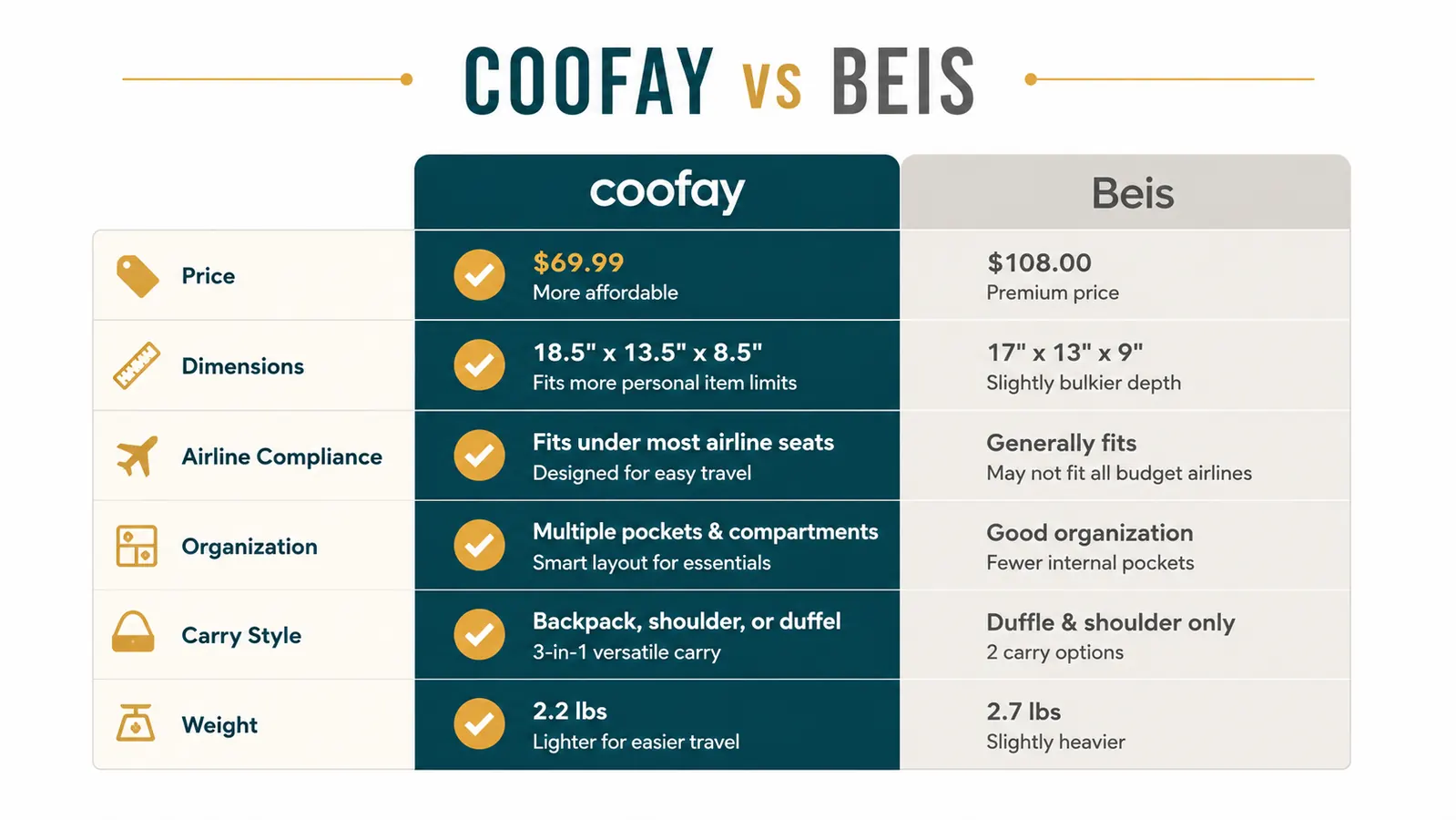
| Category | coofay Travel Backpack | Beis The Weekend Bag |
|---|---|---|
| Price | ~$24 (current Amazon price) | ~$178 (brand site) |
| Dimensions | 18 x 12 x 8 in | 20 x 13 x 9 in |
| Airline personal item compliance | Fits Spirit, Frontier, Basic Economy under-seat specs | Borderline on strict carriers, depends on stuffing |
| Primary carry style | Backpack (hands-free) | Top handle / shoulder strap (hand carry) |
| Organization | 7 compartments, laptop sleeve, USB pass-through port | 4 main sections, exterior zip pocket |
| Weight empty | 1.1 lbs | 2.8 lbs |
| Waterproof exterior | Yes (coated nylon) | No (canvas exterior) |
| Rating / reviews | 4.6 stars / 10,411 reviews | ~4.3 stars / brand site only |
Where Beis Wins
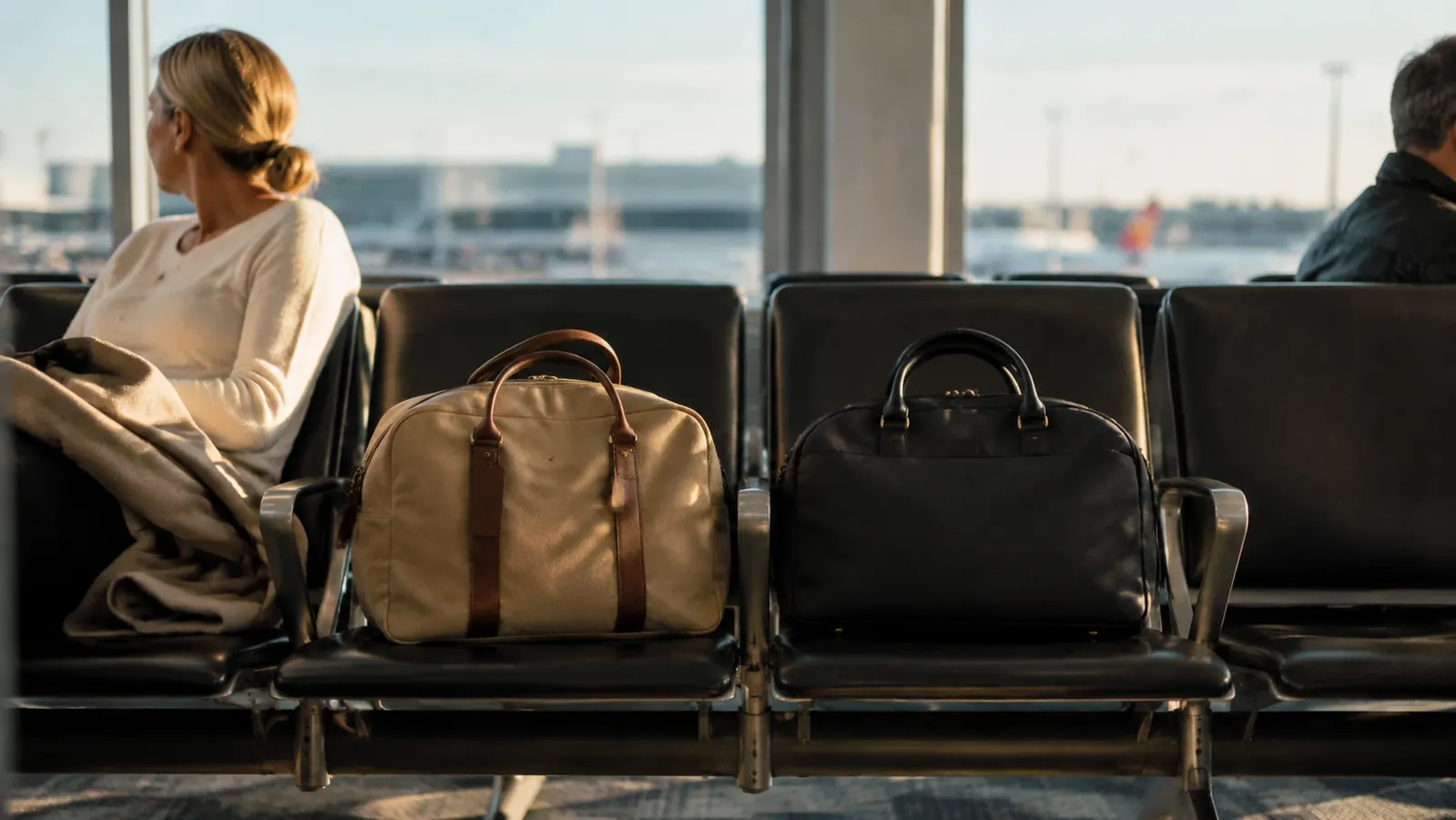
I am going to start here because I think it is honest to. Beis has built something genuinely attractive. The hardware is a cut above anything in the sub-$50 personal item category: the zipper pulls feel solid, the top handle has real weight to it, and the colorways they offer are actually interesting rather than the black-or-black-or-charcoal palette that dominates the budget travel bag market. If you care about what your bag looks like walking through a hotel lobby or a business meeting, Beis looks the part.
The structure is also real. Beis bags hold their shape in a way that a soft-sided backpack never will, which matters for anyone who travels with fragile items, electronics, or anything that cannot be compressed. The interior layout on the weekend bag is clean and intuitive: a main compartment with a padded laptop sleeve, a front exterior zip pocket, and enough internal room to pack for a two-night trip without stuffing. If the trip involves a dinner that requires you to look presentable, a structured bag is also just easier to pack a blazer flat into.
Where coofay Wins
coofay wins on the variables that matter most when you are actually flying. The first is under-seat fit. At 18 x 12 x 8 inches and 1.1 pounds empty, it clears the personal item dimensions for Spirit (18 x 14 x 8), Frontier (18 x 14 x 8), and United Basic Economy (17 x 10 x 9 -- though that one is tight on every bag). The Beis weekend bag at 20 x 13 x 9 is already at or over the personal item limit for the budget carriers that actually enforce the sizer. I have seen gate agents at FLL wave through bags they should not have, but I have also seen them charge $99 at the gate on a busy Friday. I would rather not find out which kind of agent I get.
The second win is hands-free carry. This sounds minor until you are at a security checkpoint, holding a boarding pass on your phone, trying to get your laptop out of your bag, and also managing a carry-on. A backpack clears all of that more gracefully than a top-handle tote. It also matters when you are walking a mile between gates at ORD or dragging your carry-on through a busy European train station. Your arms do not get tired. You do not put the bag down to rest your grip. You just move.
The third win is weight. At 1.1 pounds empty, the coofay adds almost nothing to your carry-on load. The Beis at 2.8 pounds empty means you have spent nearly three pounds of your personal item budget before you have packed a single sock. On a long travel day that starts at 5 AM and ends at midnight, empty bag weight is not trivial.
Beis built something worth $178 for certain travelers. But the traveler who is optimizing for airline compliance, hands-free carry, and under-seat fit every single time does not need to spend $178 to get there.
Still paying for overhead bin upgrades because your personal item won't fit under the seat?
The coofay travel backpack fits Spirit, Frontier, and Basic Economy personal item specs. It weighs 1.1 pounds empty, handles laptops up to 15.6 inches, and has a USB pass-through port for charging during the flight. Over 10,000 reviewers have confirmed the fit. Check whether it's still in stock at today's price.
Amazon Check Today's Price on Amazon →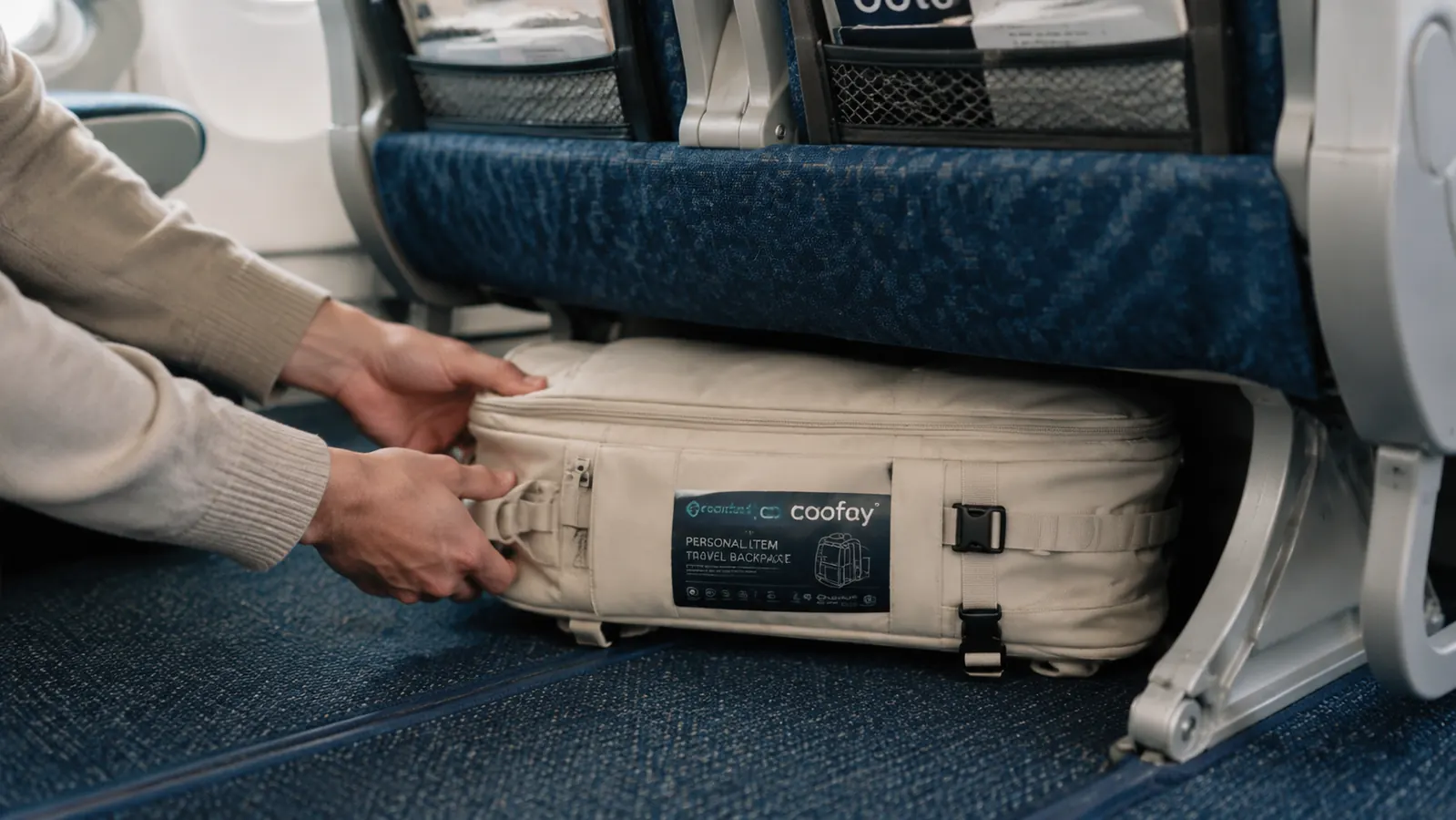
The Organization Comparison Is Closer Than You Think
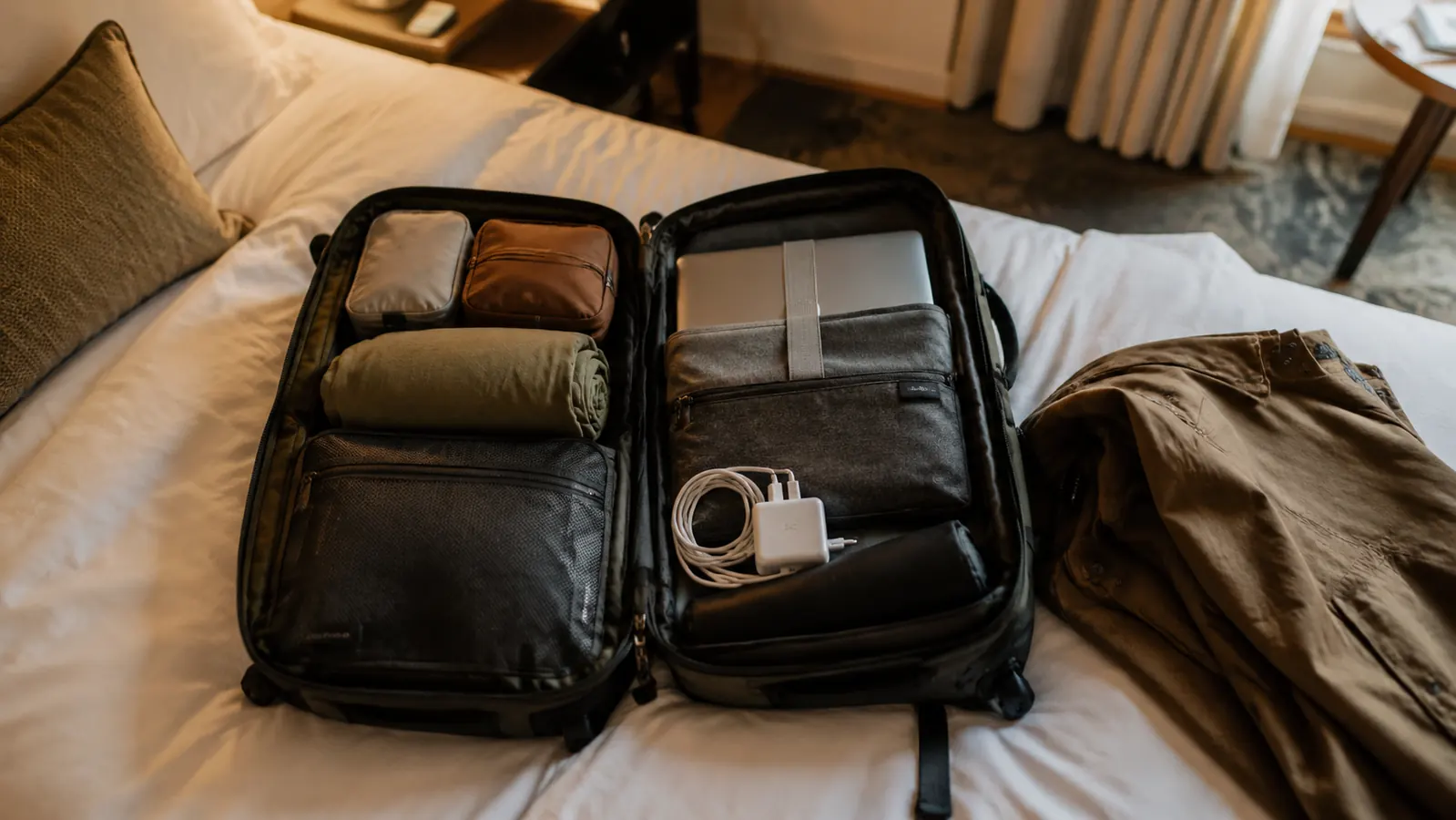
One area where I expected coofay to lose badly was interior organization. Budget bags often have a main compartment and one zip pocket and call it done. The coofay surprised me here. It has seven distinct compartments: a padded laptop sleeve that fits up to 15.6 inches, a main compartment deep enough for a change of clothes and toiletries, a front organizer section with card slots and pen loops, a top quick-access pocket, a hidden back security pocket, a side water bottle pocket, and a USB port wired to an internal charging cable loop. That is more organized than most bags in the $60-80 range, let alone the sub-$30 tier.
Beis is cleaner, not more organized. The weekend bag's main section is generous and easy to access, but you get four main zones versus seven. For travelers who want everything in its dedicated pocket, the coofay is the more deliberate design. For travelers who prefer to throw everything into a large open compartment and dig when needed, Beis wins on interior simplicity.
The Waterproofing Gap
The coofay uses a coated nylon exterior rated as water resistant. I have carried it through a genuine Seattle downpour walking from a rideshare to a terminal and the contents came out dry. The Beis weekend bag uses a canvas exterior that looks premium but is not water resistant. A sudden rain on the way to the terminal with a Beis bag means your laptop is at risk unless you have a separate sleeve. For anyone traveling in variable weather, this is a real functional gap between the two bags, and it favors coofay.
What About Long-Term Durability?
This is the fairest objection to recommending a $24 bag over a $178 one. Beis builds bags meant to last, and the quality of the hardware reflects that. My honest take: the coofay has held up through 40-plus flights without a zipper pull coming loose, any seam separating, or the fabric showing any meaningful wear. The shoulder straps have not stretched out. The USB port still works. I cannot claim 200-flight durability because I do not have that data yet, but I can say that at its price point, even if you replaced it every two years you would spend less total than buying one Beis.
For travelers who want to buy once and never think about it again, Beis is the answer. For travelers who are pragmatic about gear and do not mind replacing a $24 bag if it eventually wears through, coofay is the rational call. Most one-bag minimalists I know fall into the second camp.
Who Should Buy Which
Buy the coofay if: you fly budget carriers or Basic Economy even occasionally, you want hands-free carry, you care about under-seat fit on strict planes, you travel in weather, or you want a capable personal item bag without spending more than a checked-bag fee on the bag itself. The coofay is the choice for the traveler who is optimizing the carry-on-only system from end to end and wants every component to pull its weight without adding unnecessary cost or weight to the setup.
Buy the Beis if: you only fly mainline carriers where personal item enforcement is loose, the aesthetic and hardware quality genuinely matter to you, you travel primarily with fragile or structured items, or you want a bag that doubles as a weekender bag on the street and in a hotel lobby without looking like a backpacker. Beis earns its price for that specific traveler. It just is not the right bag for the carry-on minimalist who is treating their personal item as an extension of a packing system built around compliance and hands-free mobility.
The coofay fits where Beis won't, costs less than a checked bag fee, and weighs less than a hardcover book.
If you are flying carry-on only and need a personal item that actually clears the under-seat size spec on Spirit and Frontier, the coofay travel backpack is the practical choice. Verified at 4.6 stars across more than 10,000 purchases. See whether today's price is still under $25.
Amazon Check Today's Price on Amazon →