The winter trip that broke my system was a seven-day December run: Portland to Reykjavik, carry-on only, no exceptions. I had packed a fleece, two sweaters, a mid-layer, and a down puffer that technically could compress but definitely would not stay compressed once it hit the overhead bin. I was standing in my living room the night before, staring at my Travelpro, trying to will physics to cooperate. That is when I ordered a pack of Amazon Basics vacuum storage bags on overnight shipping, mostly out of desperation. That was eighteen months ago. I have not packed for a cold-weather trip without them since.
These bags have a 4.4-star rating across nearly 90,000 reviews on Amazon, and my experience tracks with that number almost exactly. Not five stars, not three. Four-point-something, with specific caveats that matter a lot for carry-on travel and almost not at all for the typical use case of seasonal closet storage. I am going to tell you what those caveats are, because most reviewers are writing from a linen closet, not a gate at O'Hare.
Quick Verdict
Genuinely useful for cold-weather carry-on travel when you use the roll method correctly. The double-zip seal holds across 20-plus compressions if you do not rush it. Not magic, not junk: a $10 tool that solves one specific problem well.
Amazon Check Today's Price →Still losing half your suitcase to one sweater? These bags fix that for about $10.
The Amazon Basics vacuum bags I have used for 18 months of carry-on-only cold weather travel are still available at their current price. No pump required.
Amazon Check Today's Price on Amazon →How I Have Used These Bags
I want to be specific about the conditions because context changes everything. Over eighteen months I used these bags on twelve trips that involved cold weather or bulky clothing: Iceland in December, two winter trips to Chicago (I fly carry-on even for long weekends because I refuse to pay Spirit's checked bag rate), a ski weekend in Colorado where I had to pack base layers plus apres gear, a trip to Edinburgh in October, and a mix of shoulder-season domestic flights where the weather reports changed between booking and travel. I also used them on six warm-weather trips specifically for the return trip, sealing dirty laundry to contain smell and reclaim suitcase space. That last use case surprised me. More on that later.
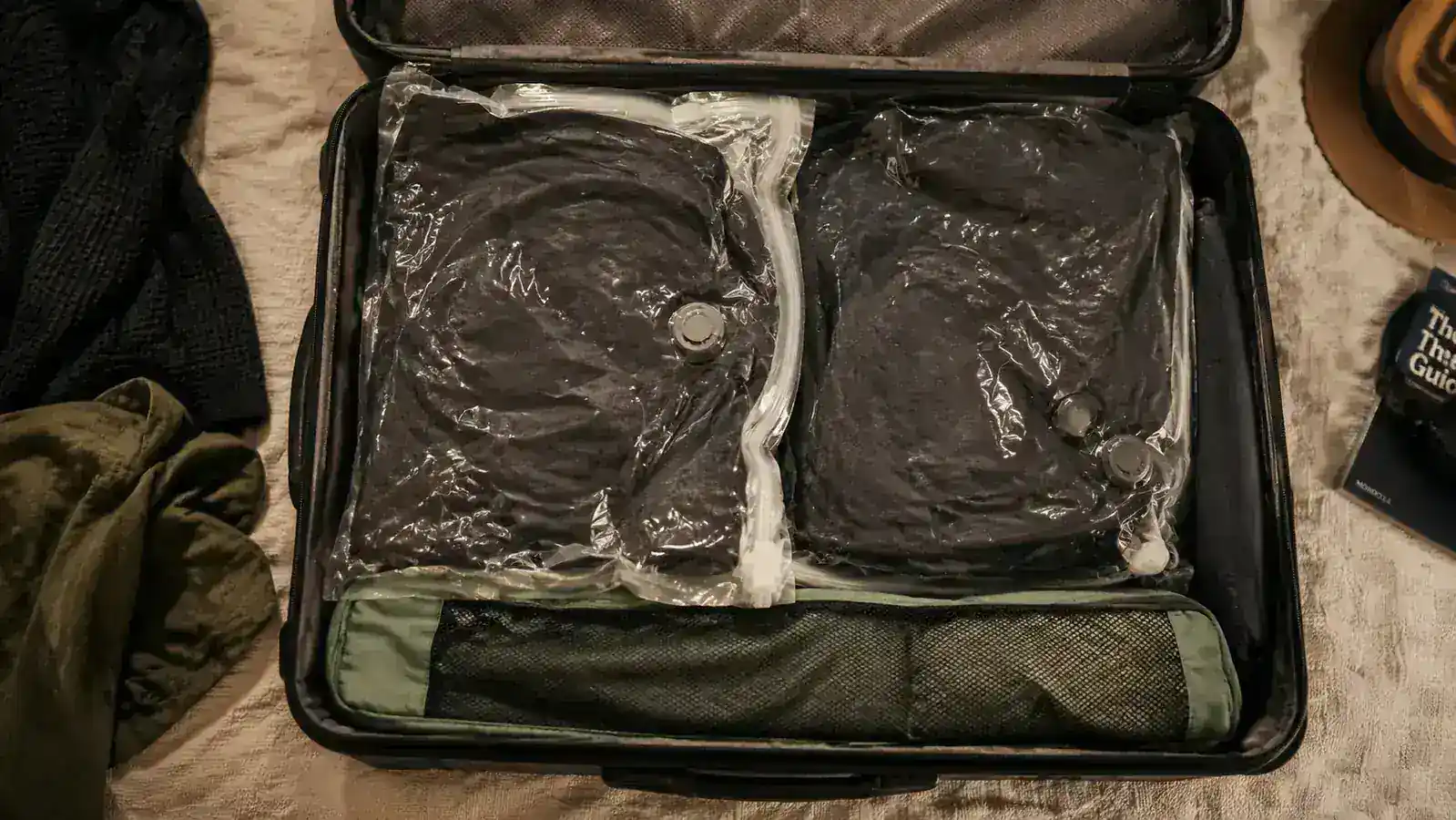
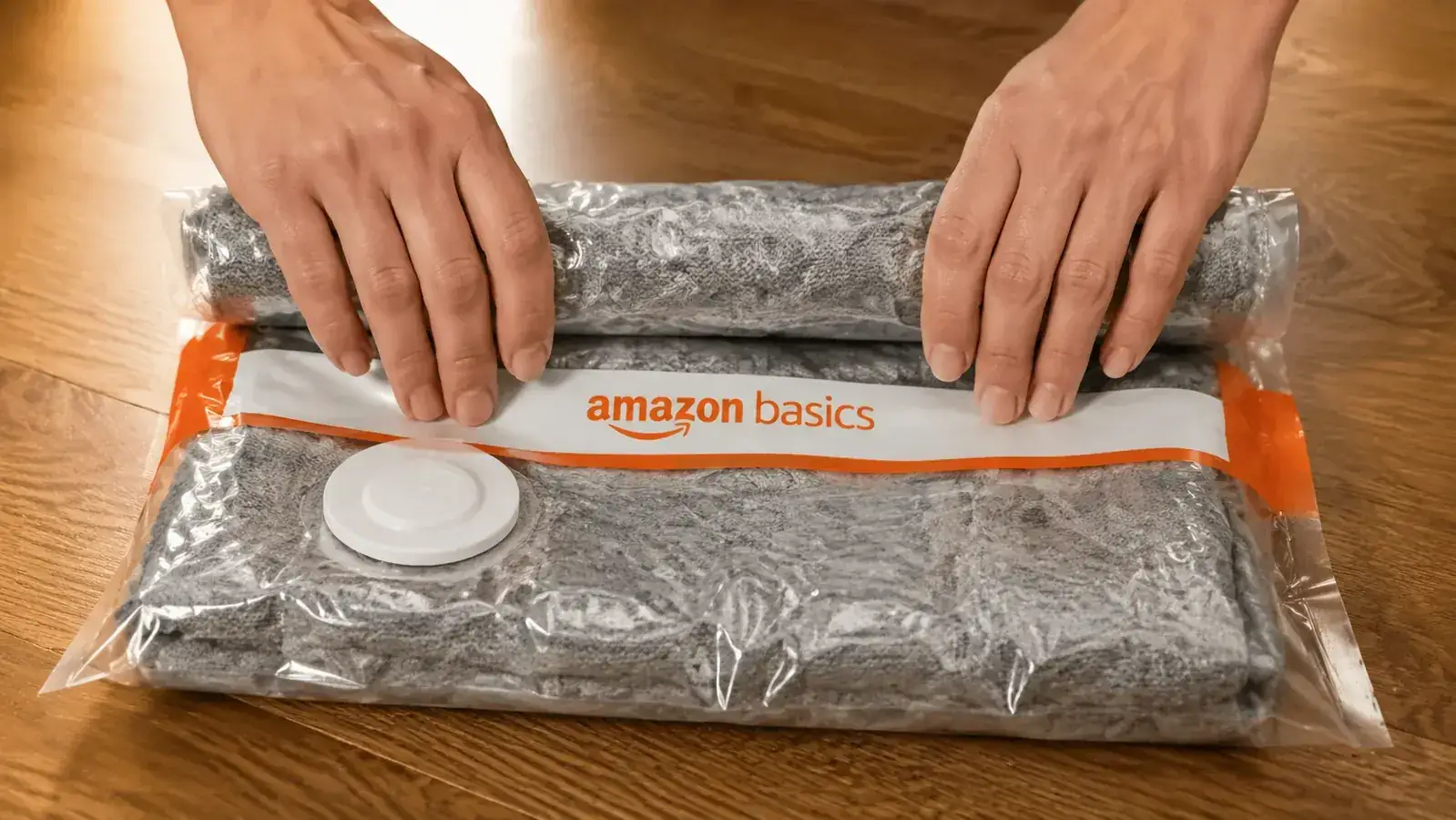
My setup for almost every trip that involves any cold-weather clothing: one large vacuum bag for the bulky pieces (sweaters, mid-layers, the puffer), one medium bag for base layers or extra shirts. I do not use the valve. I have never once used the vacuum attachment on these bags during travel. The whole appeal for carry-on travelers is the roll-up method: stuff the bag, seal the double-zip most of the way, fold the bag over itself repeatedly from the bottom, forcing air toward the open corner, then seal that last inch of zipper at the end. It is a two-minute process once you have done it three or four times. The first time takes about six minutes and feels unreliable until you realize the air is actually escaping.
The No-Pump Roll Method: What Nobody Explains Well
Every listing photo shows someone using a vacuum cleaner hose. Ignore that. If you are using these for carry-on travel, you do not have a vacuum with you, and even if your hotel has one, hunting it down at 5:30 AM before a flight is not a real solution. The roll method is the whole game, and it works, but there are two things that will trip you up if no one explains them first.
First: the bag has to be lying flat on a hard surface, not on a bed or couch. I did it on my hotel bed in Copenhagen and got maybe 40 percent of the compression I expected. The soft surface lets the bottom of the bag balloon instead of forcing air toward the zipper. Hard floor, desk, bathroom counter. Second: the double-zip needs to be seated properly before you start rolling, not just pressed together. You feel it click into each groove as you run a finger along it. If you skip this step and go straight to rolling, you get one good compression and then the bag pops back open as you move it into the suitcase. I made this mistake three times before I understood it was a technique problem, not a product defect.
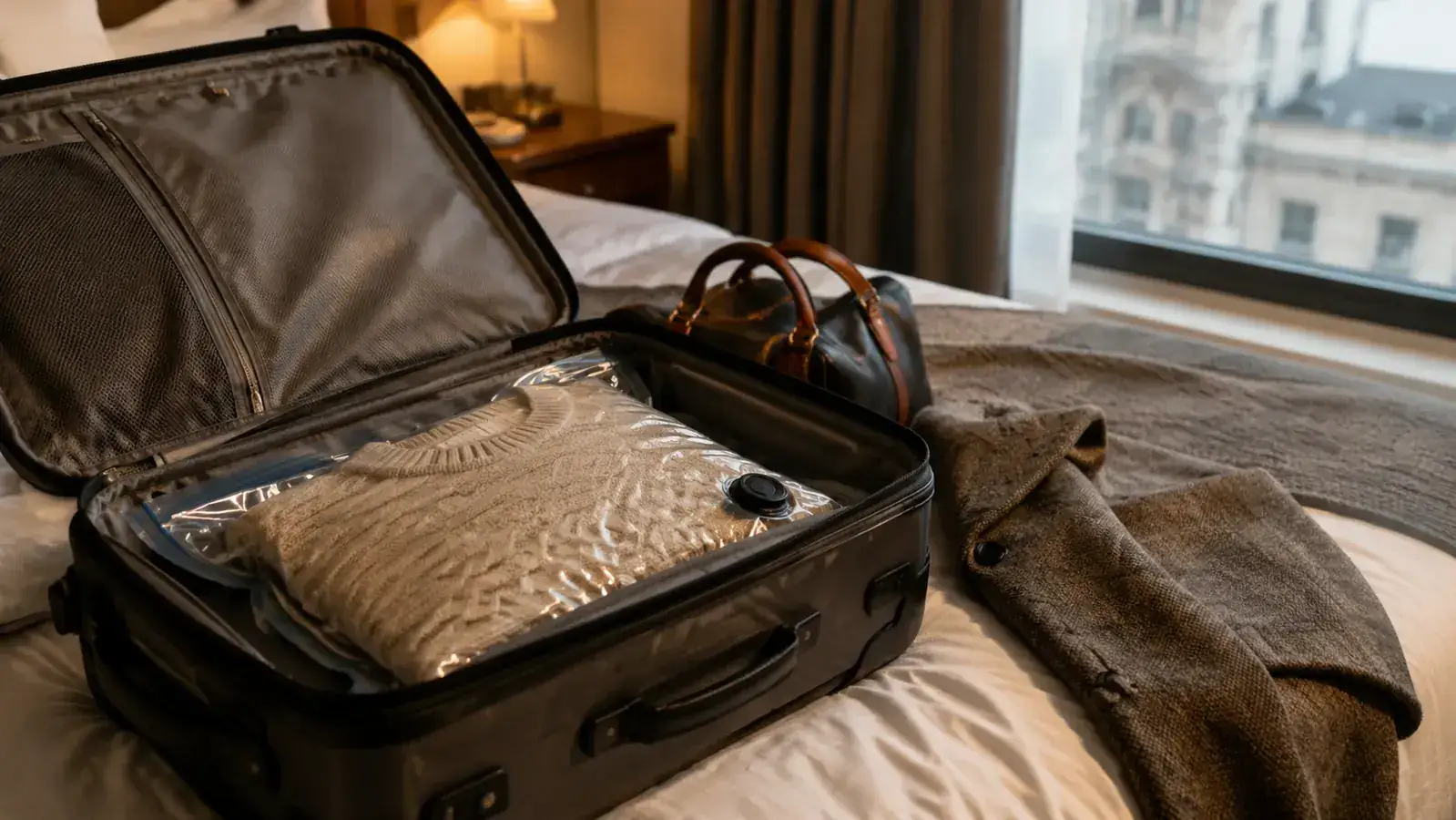
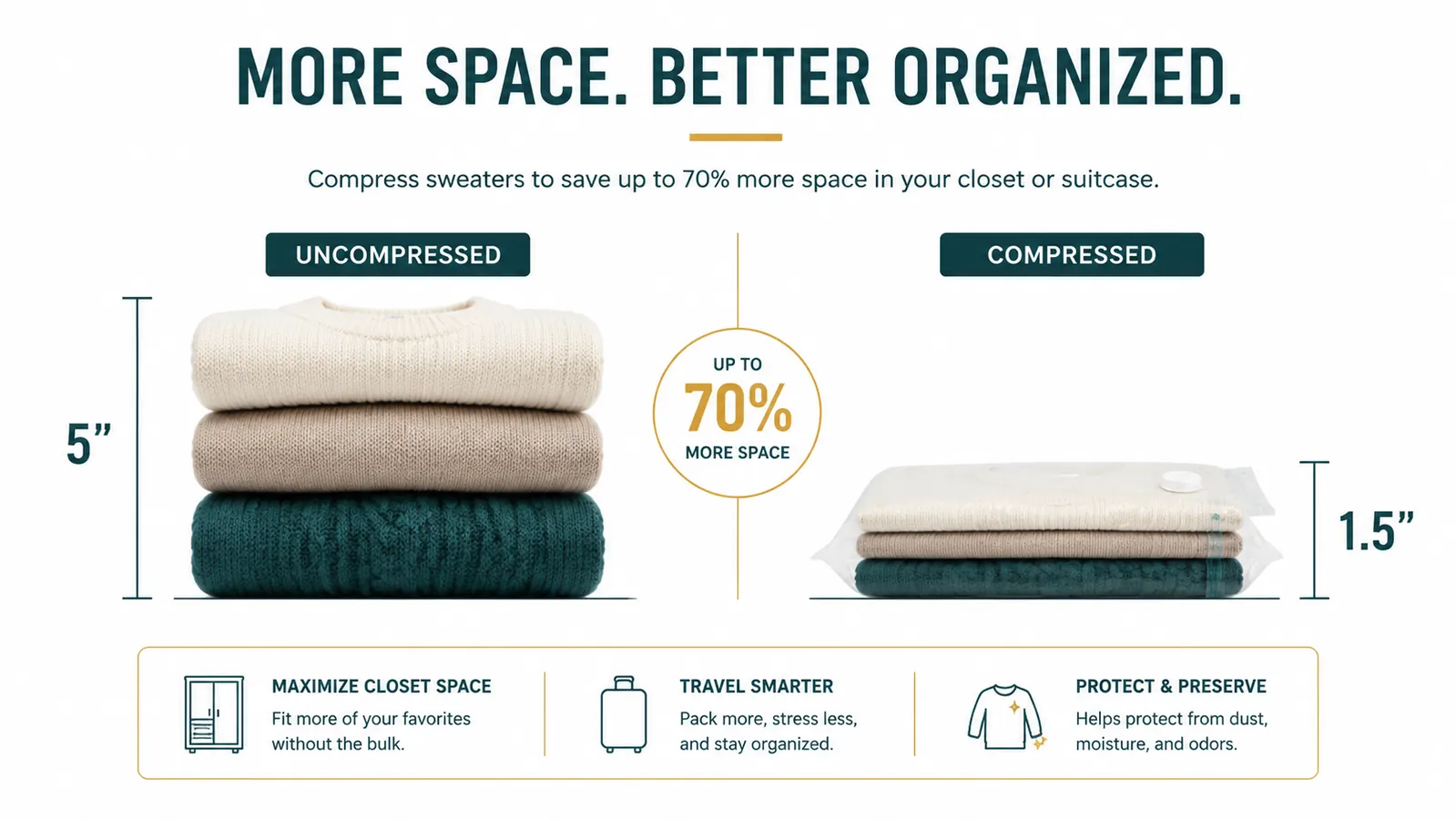
Once you have the technique down, the compression ratio is genuinely impressive. Three medium sweaters that would fill about five inches of stack height in my Travelpro compress to roughly an inch and a half. That is not an exaggeration and not a best-case scenario: I measured this after my third trip because I did not believe it either. A chunky cable-knit that I had basically resigned to being a checked-bag item fits comfortably inside the large bag alongside a fleece and a mid-layer, and the combined sealed bag is maybe two centimeters thick.
Seal Integrity After Twenty-Plus Uses
This is the section that matters most for anyone thinking about carry-on travel, because the promise of a vacuum bag is useless if the seal fails in your suitcase at 35,000 feet. I can tell you: over eighteen months, I have had three seal failures out of what I estimate to be around 30 to 35 compressions across four bags. Two of those failures happened with my original set, which I have used heavily. One happened with a newer bag I tore open clumsily when unpacking. All three failures were partial, meaning the bag re-inflated slowly rather than instantly, and in two cases the clothing inside was still notably more compressed than if I had packed it loose.
The seals that failed had one thing in common: I had rolled them while the contents were slightly damp. The puffer that I brought back from a rainy day in Edinburgh and tried to pack before it was fully dry lost its seal by the time I got to the airport. The bag had inflated back to about sixty percent of its original size. Not catastrophic but not the result I wanted. Dry contents only. That is the rule. If you need to pack workout clothes or a swimsuit that is not completely dry, use a separate waterproof bag first, let it do its job as a moisture barrier, and then compress it.
Three sweaters that take up five inches of suitcase space flat compress to an inch and a half. I measured this. It is not marketing math.
Winter Coats and What These Bags Cannot Do
I want to be direct about the limits before you buy based on the wrong expectation. A full heavy wool overcoat does not work with carry-on vacuum bags, period. It is too thick, too structured, and it will not compress into something that fits reasonably inside a 21-inch carry-on even fully sealed. I tried this once with a mid-weight pea coat and ended up with a compressed slab that was stiff and took up almost as much volume as the coat folded flat. The coat also came out extremely wrinkled in a way that a day of hanging did not fully fix.
What these bags do handle well: down jackets and puffers (compresses to almost nothing), wool and cotton sweaters, fleeces and mid-layers, hoodies, and base layers. Anything with natural loft that squashes under pressure is a good candidate. Anything structural or woven tightly does not compress meaningfully and comes out looking like it was stored under a car tire.
The Use Case I Did Not Expect: Return-Trip Dirty Laundry
I started using one medium bag specifically for dirty laundry on the return trip after a trip to New Orleans where I had a wet swimsuit, three days of sweaty clothes, and a Mardi Gras-adjacent situation that I will leave to your imagination. I sealed everything into a vacuum bag, rolled it down, and solved two problems at once: smell containment and space recovery. The bag I came home with had more room in it than the bag I left with, which should be impossible, but when you think about it, dirty clothes tend to accumulate loose items and expand in a suitcase over a trip. Compressing them into a single flat brick frees up volume for the souvenir I bought and the snacks I always pick up in airports.
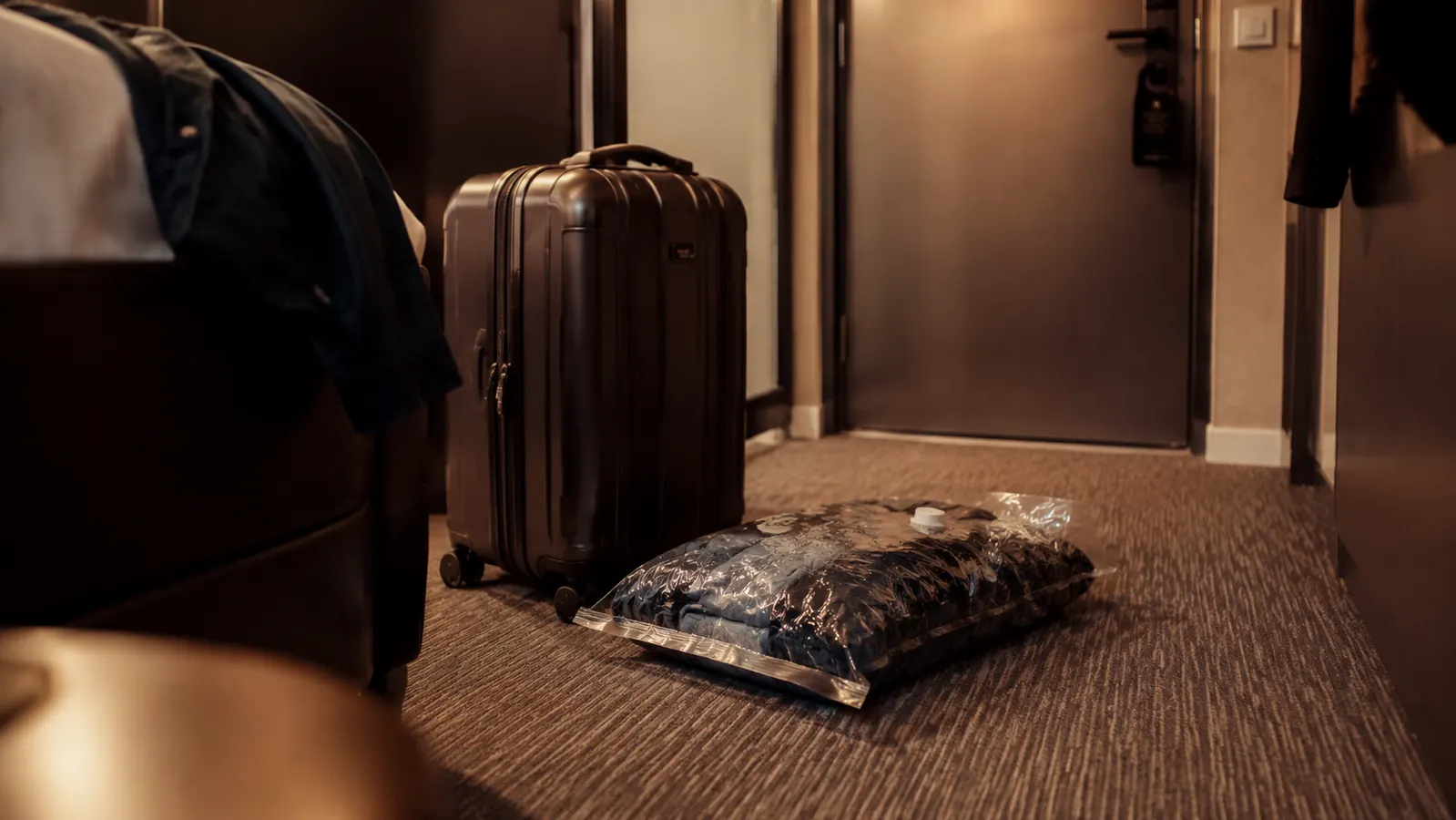
Since then I pack one medium vacuum bag specifically for this purpose even on warm-weather trips. It gets used on day five or six when the suitcase has started to feel chaotic. I also used one to store a wet hot tub swimsuit and towel combination at a mountain resort in Colorado when my bag was already tight and checkout was at 10 AM. Sealed it up, tossed it in, got on the plane, washed it at home. No drama. This is one of those small practical moves that sounds trivial until it saves your bag from smelling like a pool for the whole flight.
Size Breakdown and Which One I Use Most
The Amazon Basics set comes in multiple sizes. For carry-on travel specifically, I have found the large and medium sizes useful. The extra-large bags are designed for comforter storage, they are physically wider than a 21-inch carry-on and there is no reasonable way to fold a bag that large into a suitcase without the compression benefit disappearing. Stick to medium and large for travel use. The small bags are useful for socks and base layers if you are extremely tight on space, but at that point compression packing cubes do a similar job with less fuss.
My most-used configuration: one large bag for the outbound trip holding my puffer and two sweaters, one medium bag held in reserve for the return trip laundry. Total added weight is negligible. Total added suitcase volume when both bags are rolled and packed flat is about the same as a medium packing cube.
Pros
- Roll-up method works without a vacuum, which is the only version of these bags that makes sense for travel
- Double-zip seal holds reliably across 20-plus compressions if the contents are dry and the seal is seated correctly
- Down puffers and fleeces compress to a fraction of their packed size, enough to meaningfully change what fits in a carry-on
- Very inexpensive per bag and reusable across dozens of trips
- Doubles as smell containment for dirty laundry on return trips
Cons
- Seal integrity degrades if you compress damp or wet items, bags will re-inflate during the flight
- Does not work on structured coats or tightly woven fabrics, compression is minimal and wrinkling is severe
- Extra-large size is useless for travel, the bag is wider than a standard carry-on
- Requires a flat hard surface for best compression, soft beds and couches give 40 to 50 percent worse results
- Bags can tear at the corners if you handle them roughly during unpacking, the plastic is thin by design
Who This Is For
These bags are for the carry-on traveler who flies into cold weather and cannot negotiate their way out of bringing a puffer or multiple sweaters. If your trips are warm-weather only, or if you always fly to destinations that let you layer light, you probably do not need them. They are especially useful for anyone doing a winter city trip of five to ten days who wants to pack a down jacket without surrendering half their suitcase, anyone flying to a ski destination with a carry-on, and anyone who has ever opened their bag on a return flight to discover it smells like everything they did on vacation.
Who Should Skip It
Skip these if your cold-weather packing revolves around structured coats or blazers. They will not compress them usefully and they will wrinkle them badly. Also skip them if you are a light packer whose suitcase is already under 70 percent full. The bags only earn their place when you are genuinely space-constrained. If you have room to spare, a regular packing cube does the organizational work without the extra step of rolling and sealing. These are a volume problem solution, not an organization solution. Know what problem you actually have before buying.
If your puffer is the reason you almost checked a bag last trip, this is the fix.
The Amazon Basics vacuum storage bags I have used across twelve cold-weather trips are still available at today's price. The medium and large sizes are the ones worth buying for carry-on travel.
Amazon Check Today's Price on Amazon →