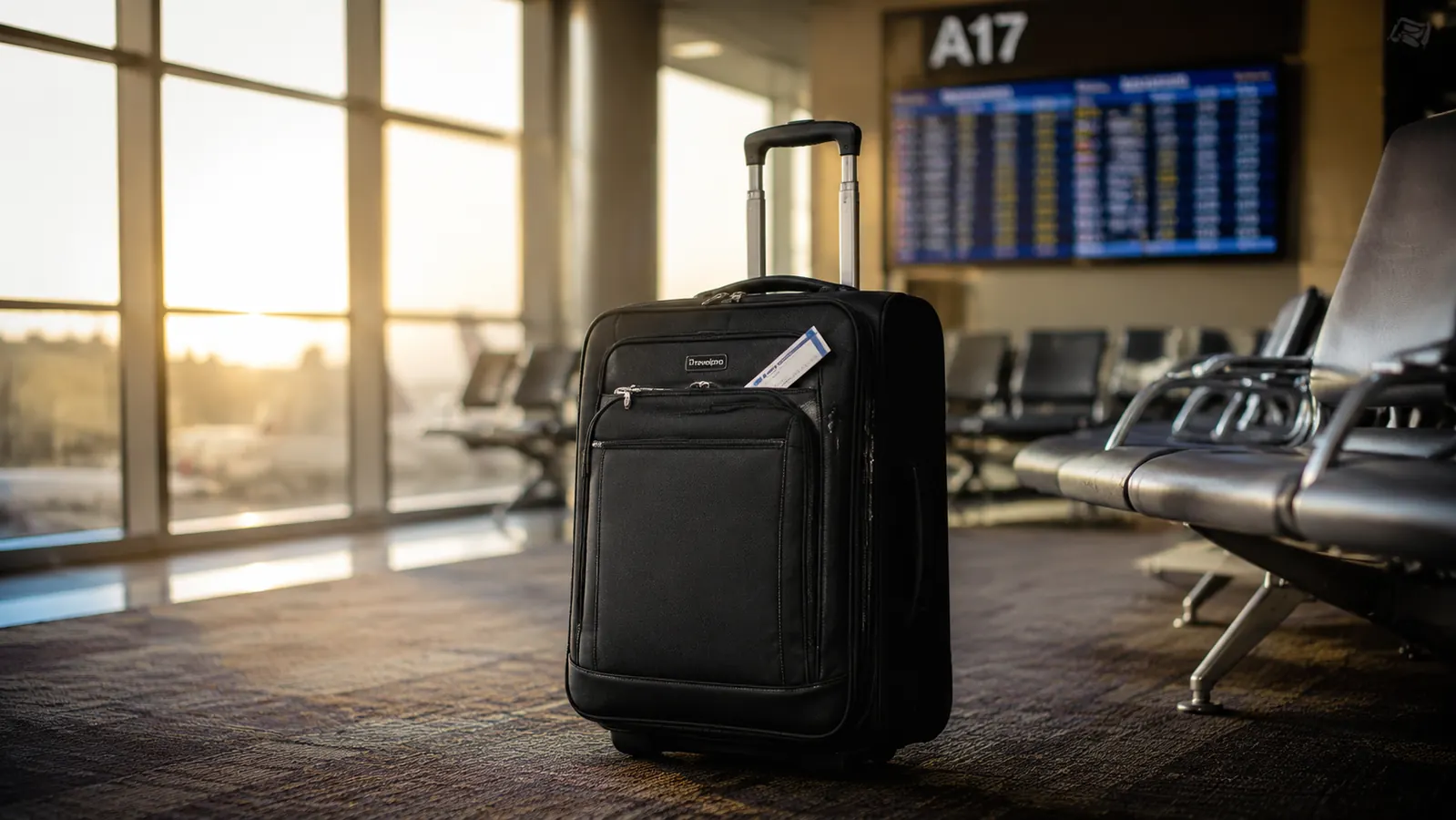
For six years I checked a bag on almost every trip. I told myself I needed the extra space. What I actually needed was a system. The checked-bag line at O'Hare on a Sunday afternoon will eventually teach you that lesson, or a Spirit agent in Fort Lauderdale yanking your roller out of the overhead bin will do it faster. Mine was the latter. That was March 2021, and I have not checked a bag since.
The bag I switched to was the Travelpro Maxlite 5 Softside 21-inch carry-on, and it is still the bag I use today. Not because it is the most beautiful suitcase on the market. Because it is 6.8 lbs empty, fits the bin on a CRJ-700 and a 777, and has never lost a wheel in 80-plus flights. But the bag alone did not solve my problem. The system did. This is that system, start to finish.
If you keep checking bags because your carry-on is too heavy or too small, the Maxlite 5 solves both problems at once.
At 6.8 lbs empty, it is one of the lightest full-size carry-ons in this size class. 4.5 stars across 13,000+ reviews from travelers who fly as often as you do.
Amazon Check Today's Price on Amazon →Step 1: Commit to the Weight Budget Before You Pack a Single Item
Most people approach carry-on travel backwards. They pack everything they think they need, then try to cram it into a bag. You will fail every time that way. The right starting point is your weight budget. Most domestic airlines allow carry-on bags without a weight limit for overhead bins, but international carriers are stricter, and some budget carriers in Europe cap overhead bags at 22 lbs. I use 22 lbs as my ceiling regardless of airline.
The Travelpro Maxlite 5 weighs 6.8 lbs empty. That leaves you 15.2 lbs of payload. Write that number down before you touch a single piece of clothing. If you don't know how much your toiletry bag, shoes, and tech brick weigh, put them on a kitchen scale right now. You will likely be surprised. My toiletry bag alone ran 2.4 lbs before I audited it. Shoes are typically 1.5 to 2.5 lbs per pair. You are already at 6 lbs of non-clothing weight before you pack a single shirt. Knowing this number in advance is what separates people who make carry-on travel work from people who give up and check a bag.
The Maxlite 5 helps here in a specific way: its low empty weight gives you more payload than heavier bags in the same size class. An Away Carry-On weighs 7.8 lbs empty. A Briggs and Riley Baseline weighs 8.4 lbs. Every extra pound of bag is a pound you cannot put in the bag. Over the course of a week-long trip, that difference is the choice between one pair of shoes and two.
Step 2: Audit Your Clothing List Using the 5-2-1 Formula
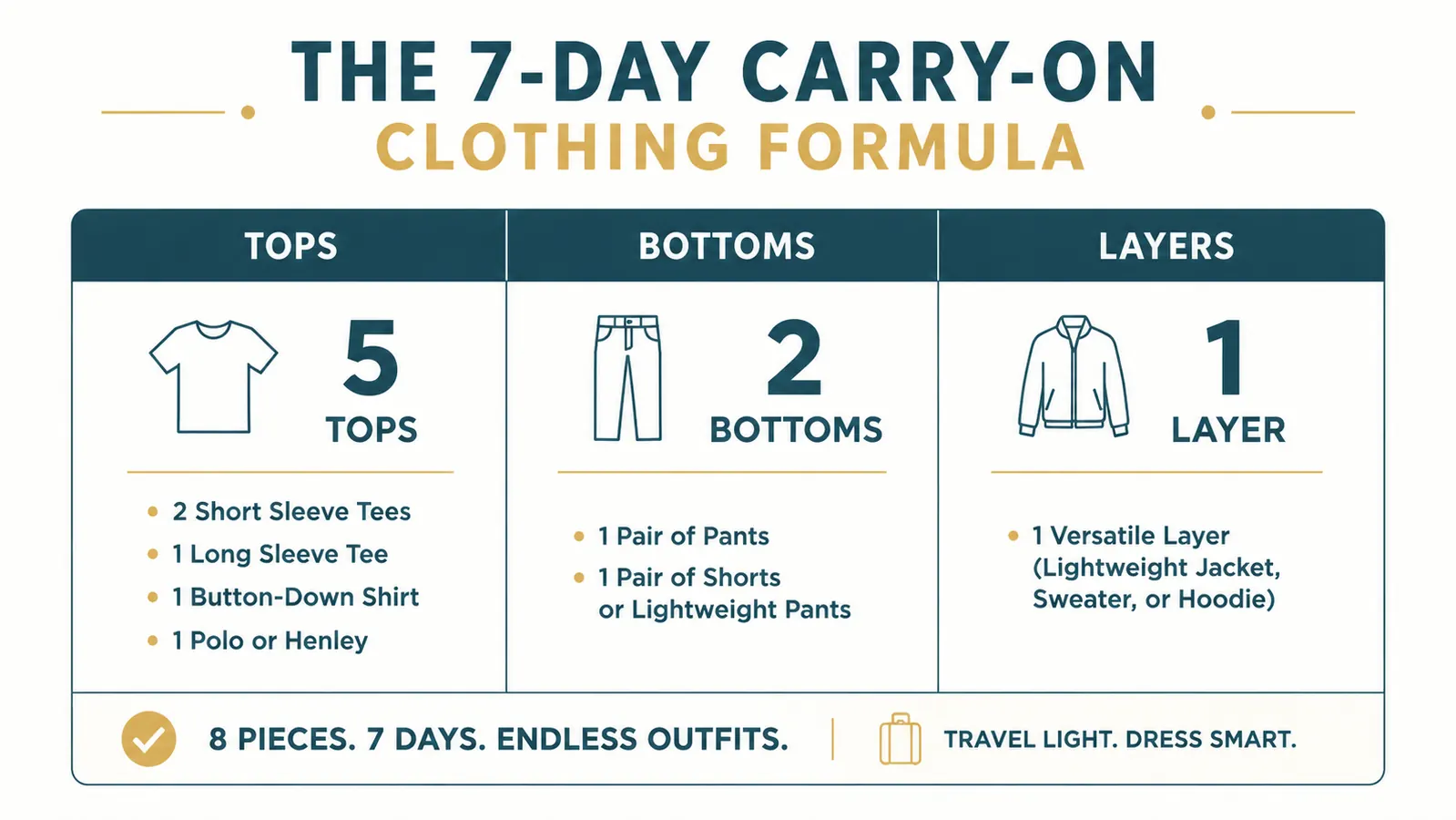
The formula that finally made seven-day carry-on trips work for me is 5-2-1: five tops, two bottoms, one layer. That is your clothing core. Tops are the high-turnover item. Bottoms and layers are the low-turnover items. Jeans and slacks do not need to be washed after every wear. A merino cardigan can go four or five wears before it smells. But a T-shirt on day three of a heat wave needs to be retired. Five tops for seven days means you are hand-washing or using a hotel laundry service once. That is the price of not checking a bag.
Where this formula breaks down for most people is shoes. Shoes are volumetrically expensive inside a 21-inch bag. The Maxlite 5's main compartment is roomy enough for the 5-2-1 core plus a pair of sneakers and one dress shoe if you pack them in the corners and use the expansion zipper. But if you are bringing three pairs of shoes, the formula collapses and you will be back at the check-in counter. Pick one pair that covers 80 percent of your trip's situations. For most trips that is a clean sneaker or a leather loafer. The other 20 percent can usually be handled by whatever you wear through the airport.
For a longer walkthrough on clothing quantities and the logic behind them, my piece on how to pack a full week into a single carry-on covers the cube-based system I use to verify the count fits before I close the bag.
Step 3: Restructure Your Toiletry Bag for TSA Once and Leave It That Way
The 3-1-1 rule is not the obstacle most people think it is, but it requires a one-time restructuring of how you think about toiletries. The rule: liquids, gels, and aerosols in containers of 3.4 oz or less, all fitting in a single quart-sized clear bag. One bag per person. Where travelers go wrong is trying to squeeze their full-size products into the quart bag. Do not try to fit your 8 oz shampoo into a 3.4 oz travel bottle every trip. Buy travel-size products once, leave them in your kit, and refill them when they run out.
The Travelpro Maxlite 5's front exterior pocket is exactly sized for a flat toiletry case that holds your quart bag plus a few extras like a toothbrush and razor. I keep my quart bag in that pocket pre-packed at all times. When I get back from a trip, I refill anything that ran out and zip it back up. The next trip, it is already done. This single habit, combined with a bag that has a dedicated exterior pocket for it, is what makes carry-on living sustainable rather than a project you dread before every departure.
Step 4: Learn Which Airlines Measure and Which Don't
This is the carry-on knowledge that nobody publishes in a tidy guide because it changes seasonally. The Travelpro Maxlite 5 at its listed dimensions of 21 x 15 x 9 inches fits the published overhead bin size limits for Delta, United, American, Southwest, JetBlue, and Alaska. It does not always fit the published limits for Spirit and Frontier, which use a 22 x 18 x 10 inch policy but enforce it with a physical sizer that many gate agents use at their discretion.
The practical rule: on Spirit and Frontier, do not use the expansion zipper. The Maxlite 5 has a 1.5-inch expansion that takes it from 21 to roughly 22.5 inches when fully expanded. Fully expanded, it will fail a Spirit sizer. Unzipped, it fits without drama. I have flown the Maxlite 5 on Spirit out of FLL four times without a gate check, but I always check it non-expanded. The Spirit gate agent at FLL who measured my bag twice on my first trip saw the small wheels, the slim profile when unzipped, and let it through. He specifically said the expanded bags were his problem. Know the difference.
The bag is not the hard part. The hard part is deciding what you are not bringing. Once you make peace with that, carry-on travel becomes the obvious default.
Step 5: Board Early Every Time, Without Fail
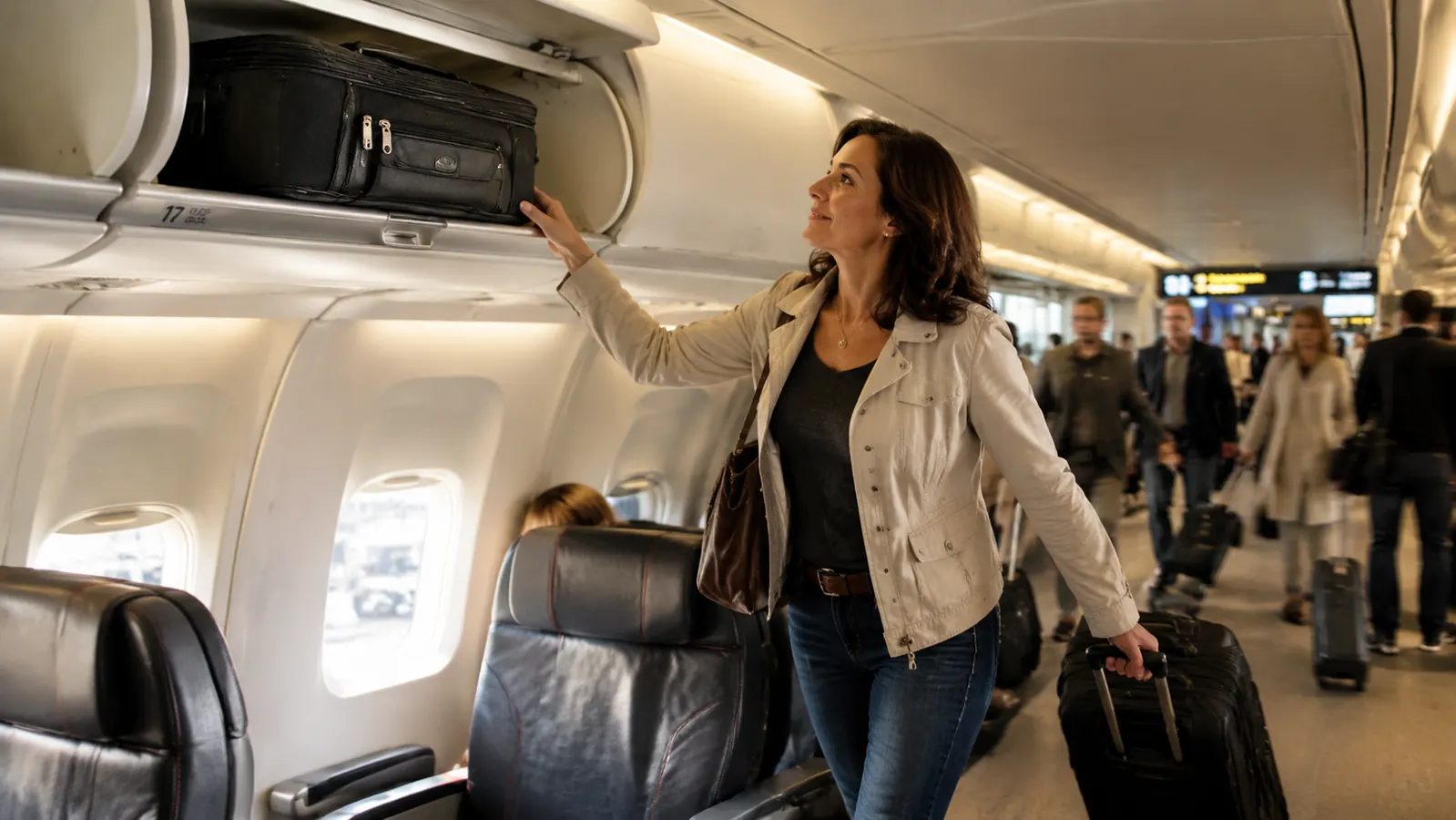
Overhead bin space is a finite resource. On a full 737 or A320, the bins are typically full by boarding group three. If you are in boarding group five and everyone in groups one through four has a carry-on, you are getting a gate check regardless of how well your bag meets the size limit. Boarding early is not a luxury for carry-on travelers. It is a functional requirement.
On airlines with paid seat selection, choose a seat in rows 15 to 25 where you board toward the middle of the plane. The bins near the front fill first because everyone stores their bag forward of their seat when possible. Rows 15 to 25 give you the right balance of bin access and boarding order. On Southwest, board in the A group. Pay the $25 for early bird check-in if you are not already doing it. The $25 is less than the checked bag fee you are trying to avoid. The Maxlite 5's four-spinner wheels and PowerScope handle make moving quickly through a boarding aisle fast, even when the aisle is crowded. That matters when you are racing the boarding group ahead of you for the last overhead space in row 22.
What Else Helps
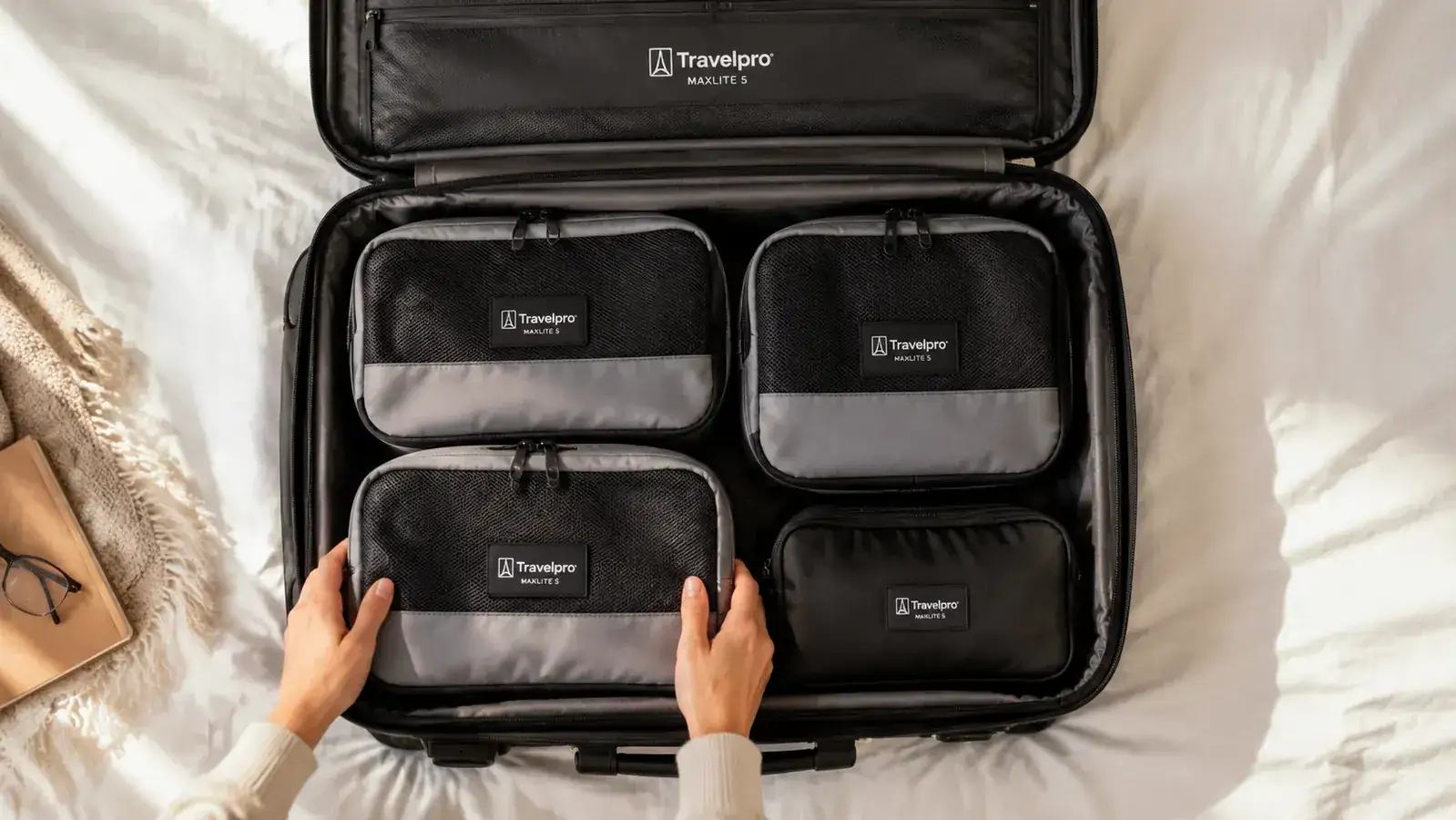
The system above is the foundation. A few additional tools make it more reliable. Packing cubes are the single biggest enabler after the bag itself. They compress soft goods, create predictable zones inside the Maxlite 5's main compartment, and let you repack after a hotel wash in under ten minutes. If you are not using packing cubes, your loose clothes are filling dead space inefficiently and you are leaving usable cubic inches on the table. The BAGAIL 8-set cubes fit the Maxlite 5 cleanly and compress merino and synthetic fabrics well. That is the combination I use.
A reusable quart bag with a wide opening is faster at security than the single-use zip-top bags most people grab at the pharmacy. TSA bins have a lip that makes dumping a wide-mouth bag easier without spilling. Small thing, but after your hundredth security line you notice the seconds it saves. The Maxlite 5's front pocket unzips fully flat, so your quart bag comes out in one motion without fishing through the main compartment.
Finally: a small luggage scale. The kind that hooks to your handle and gives you a digital readout. They weigh about two ounces and cost under ten dollars on Amazon. Weigh your packed bag at home before every trip. It takes thirty seconds and eliminates the anxiety at check-in for international flights where weight limits are enforced. The Maxlite 5 loaded under my system typically weighs between 17 and 19 lbs, comfortably inside the 22 lb ceiling I target.
The Travelpro Maxlite 5 is the bag this system is built around. If you are ready to stop checking, this is where to start.
4.5 stars, 13,000+ reviews, and light enough to leave room for everything you actually need. See the current price and available colors on Amazon.
Amazon Check Today's Price on Amazon →