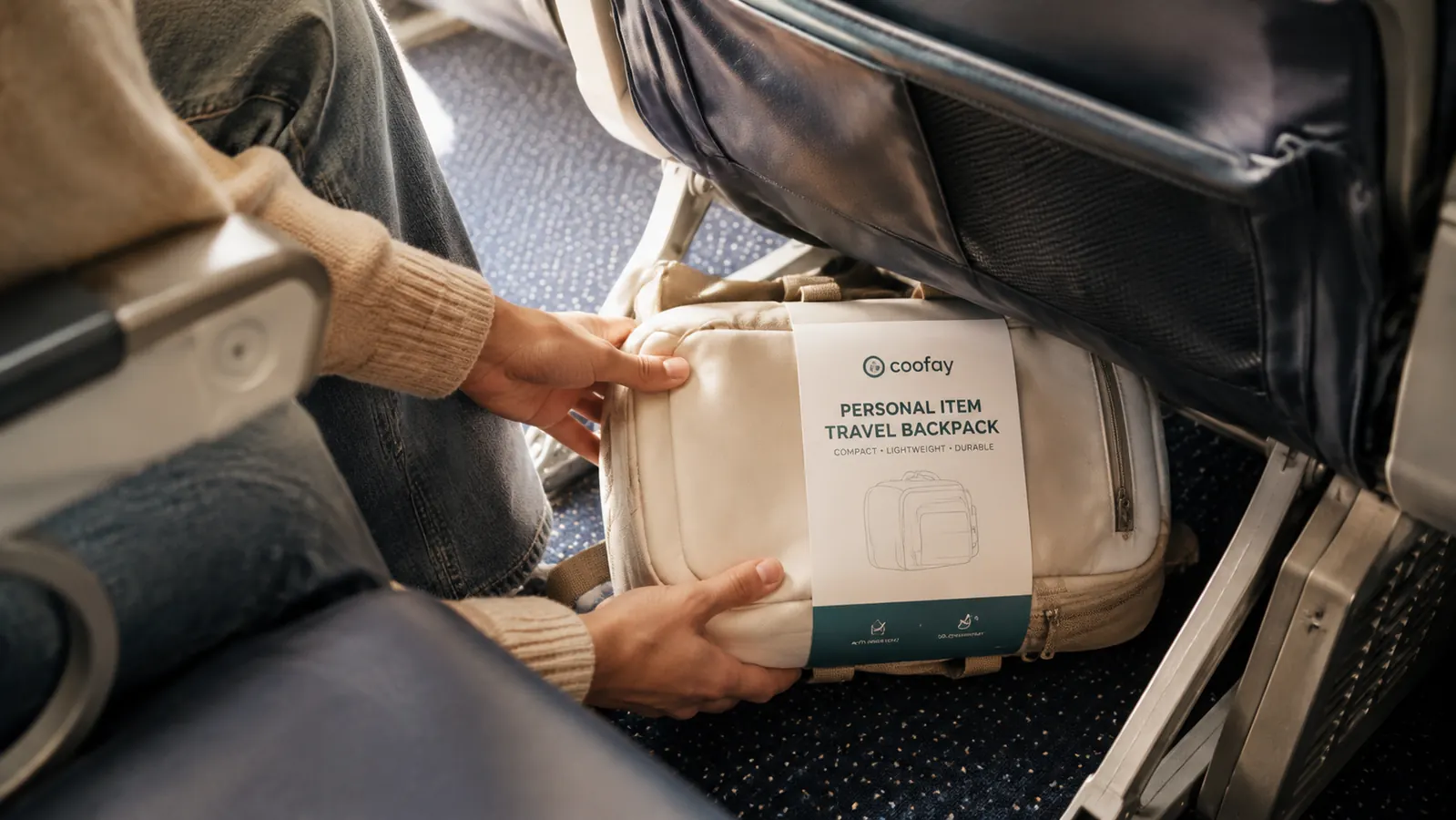
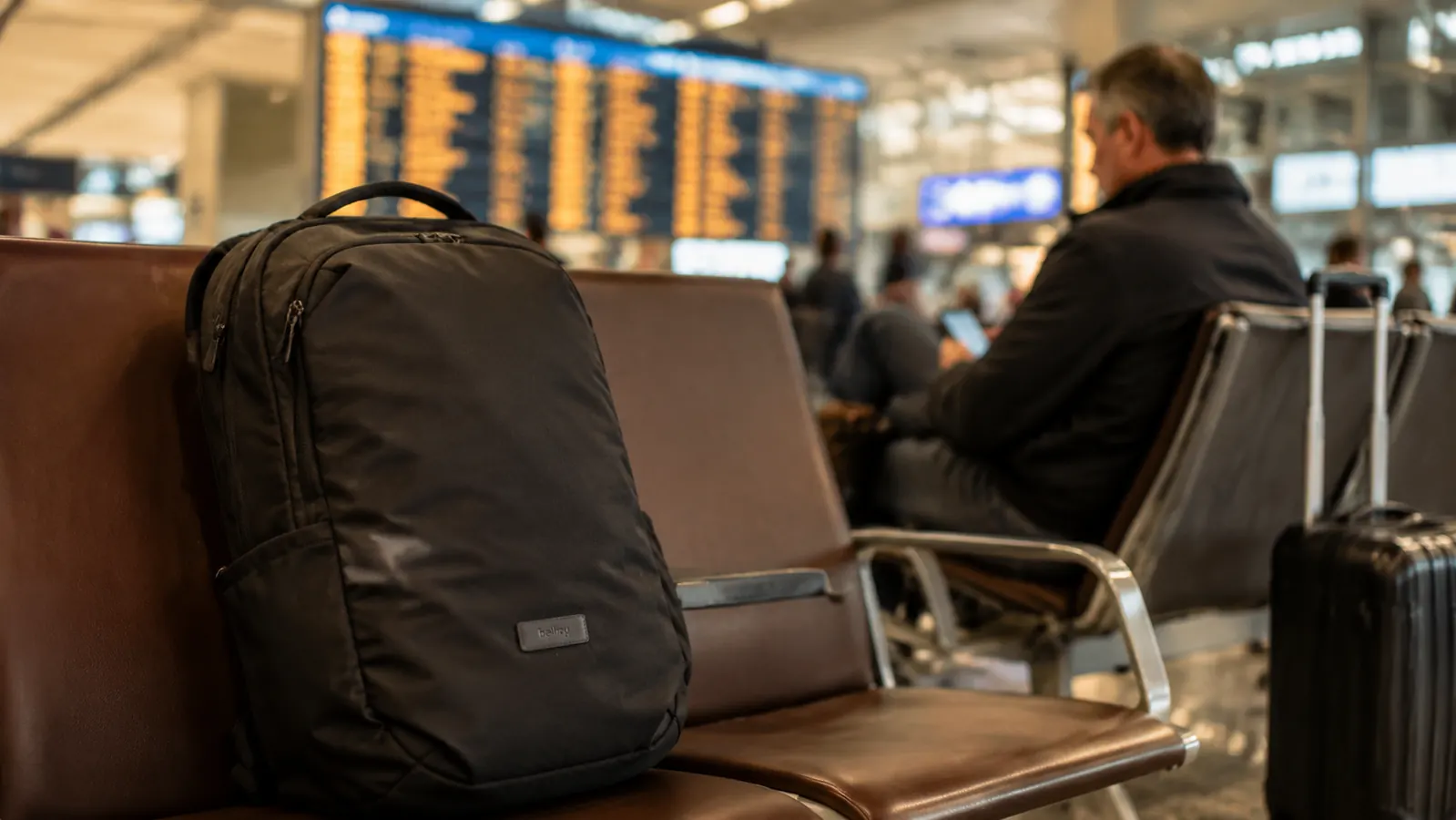
Last spring I booked a Spirit flight from Orlando to New York for $38. The catch: any bag bigger than a personal item would cost me $79 at the gate. I had four nights of meetings, two dinners out, and a gym session crammed into that trip. I packed everything into the coofay travel backpack, slid it under the seat, and walked past the gate agent without breaking stride. The couple behind me each paid $79 for their roller bags. That is the whole game right there.
Personal item packing is not about packing light in a vague, aspirational way. It is a specific skill with a specific set of rules, and once you learn the rules you can do it reliably on every trip under five nights. This guide walks through exactly how I do it, using the coofay as my go-to bag. It measures 18 x 14 x 8 inches, which clears United's 17 x 10 x 9 limit with careful loading and easily fits under the seat of a 737 or A320. I have used it on 30+ flights in the past year without a single gate-check confrontation.
Stop paying overhead bin fees. The coofay personal item backpack clears Spirit, Frontier, United, and Delta size limits.
4.6 stars across 10,000+ reviews. Waterproof, organized, and built to disappear under the seat in front of you.
Amazon Check Today's Price on Amazon →Why Your Current Bag Is Probably the Wrong Choice
Most people try to cram a rolling carry-on's worth of stuff into a bag that does not have the right structure for it. They use a drawstring gym bag that collapses onto itself, a tote that shows every lump through the fabric, or an old school backpack with one giant compartment where everything sinks to the bottom. Then they arrive at the gate, the bag looks stuffed, the gate agent asks them to try the sizer, and they fail. Not because of volume, but because of shape.
The coofay solves this with a structured top panel and a panel-load design that keeps the bag's silhouette consistent even when fully packed. It has a dedicated laptop sleeve, a front organizer pocket for cables and documents, and a main compartment that holds a surprising amount when you pack it correctly. The key distinction: it is designed to be a personal item, not a daypack that someone decided to use as one. The dimensions are intentional.
Step 1: Audit Your Airline's Personal Item Limit Before You Pack Anything
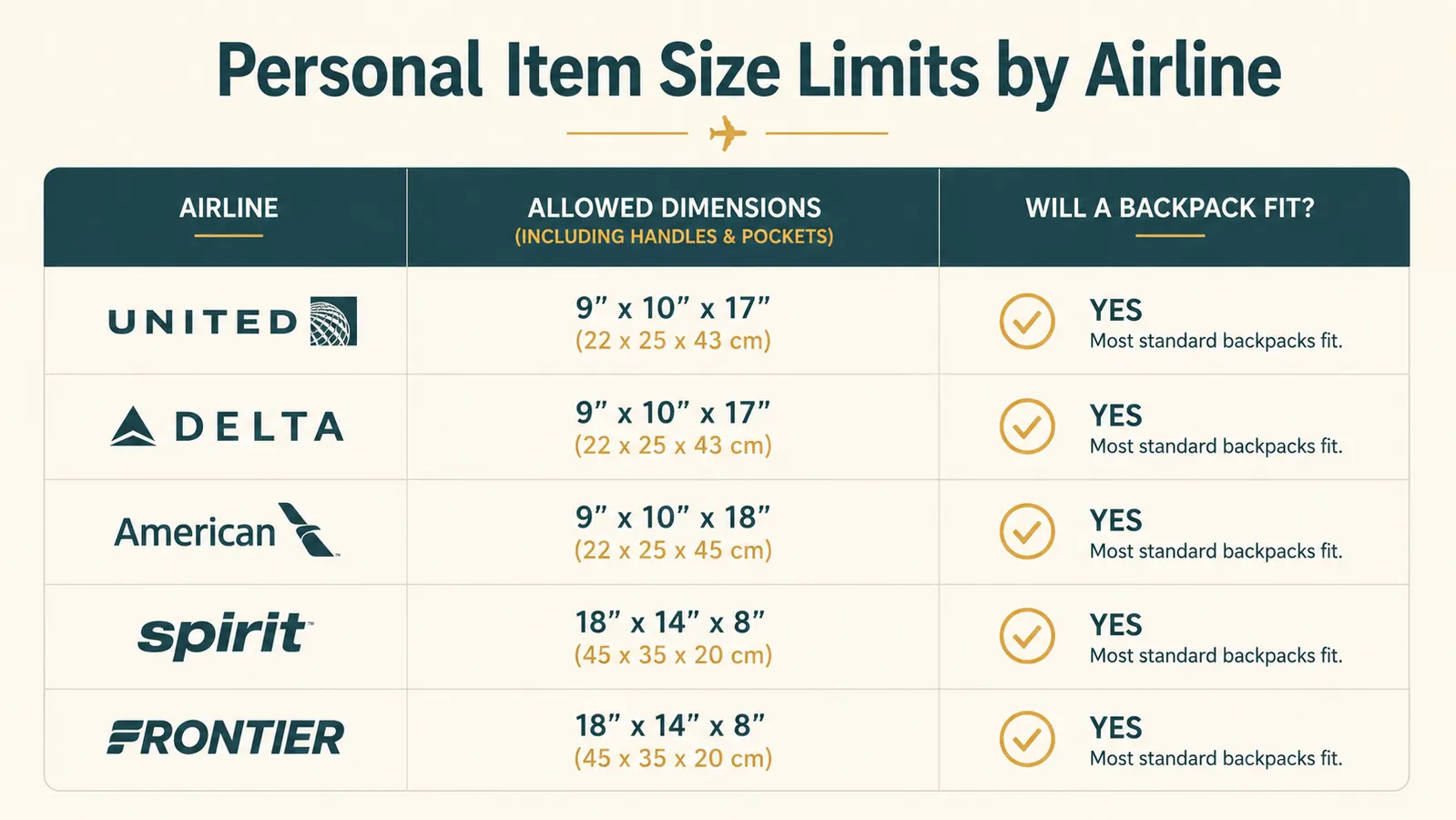
Every airline sets its own personal item dimensions and enforces them with varying levels of aggression. United allows 17 x 10 x 9 inches. Delta is more generous at 18 x 14 x 8. American matches Delta roughly. Spirit and Frontier are the strictest at 18 x 14 x 8 but are also the most likely to enforce with a sizer box at the gate. Southwest has no stated dimensions, which is almost dangerously permissive until you get a gate agent having a bad day.
The coofay's listed dimensions are 18 x 14 x 8 inches, which threads the needle for Delta, American, and the budget carriers. On United, it is technically one inch over in two dimensions when fully packed. In practice, I have never had it fail the sizer on United because a soft-sided bag compresses. The safe rule: when flying United or a strict regionals, do not pack it so full that the sides are rigid. Leave two inches of give, and you will pass.
Pull up the airline's carry-on policy page before your trip, not from memory. Airlines change these numbers quietly. Screenshot the policy and keep it on your phone. If a gate agent challenges you, you have documentation.
Step 2: Build Your Clothing List Around the Three-Day Core
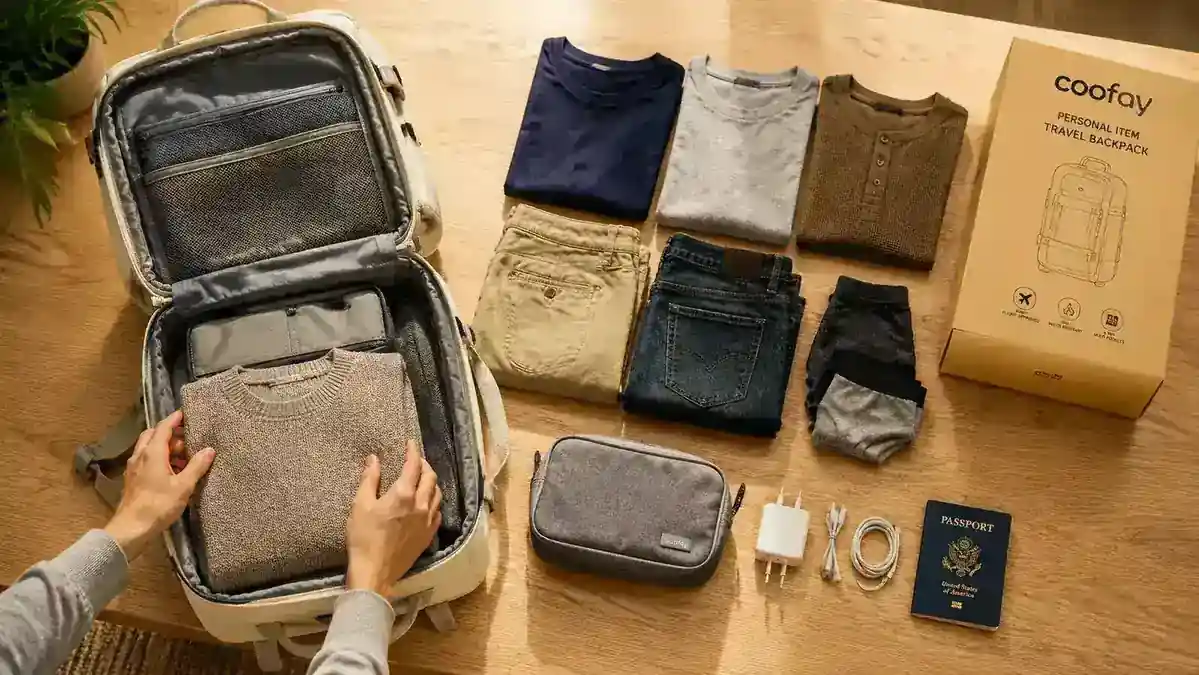
For any trip up to five nights, I use the same clothing core: three tops, two bottoms, four pairs of underwear, three pairs of socks, one lightweight layer (either a packable jacket or a merino cardigan), and whatever shoes I am wearing through the airport. That is the full clothing budget for a personal item. The math works because merino wool and quick-dry synthetic fabrics can be hand-washed in a sink and dry overnight. I buy nothing from cotton for travel. Cotton takes 48 hours to air-dry. Merino takes four.
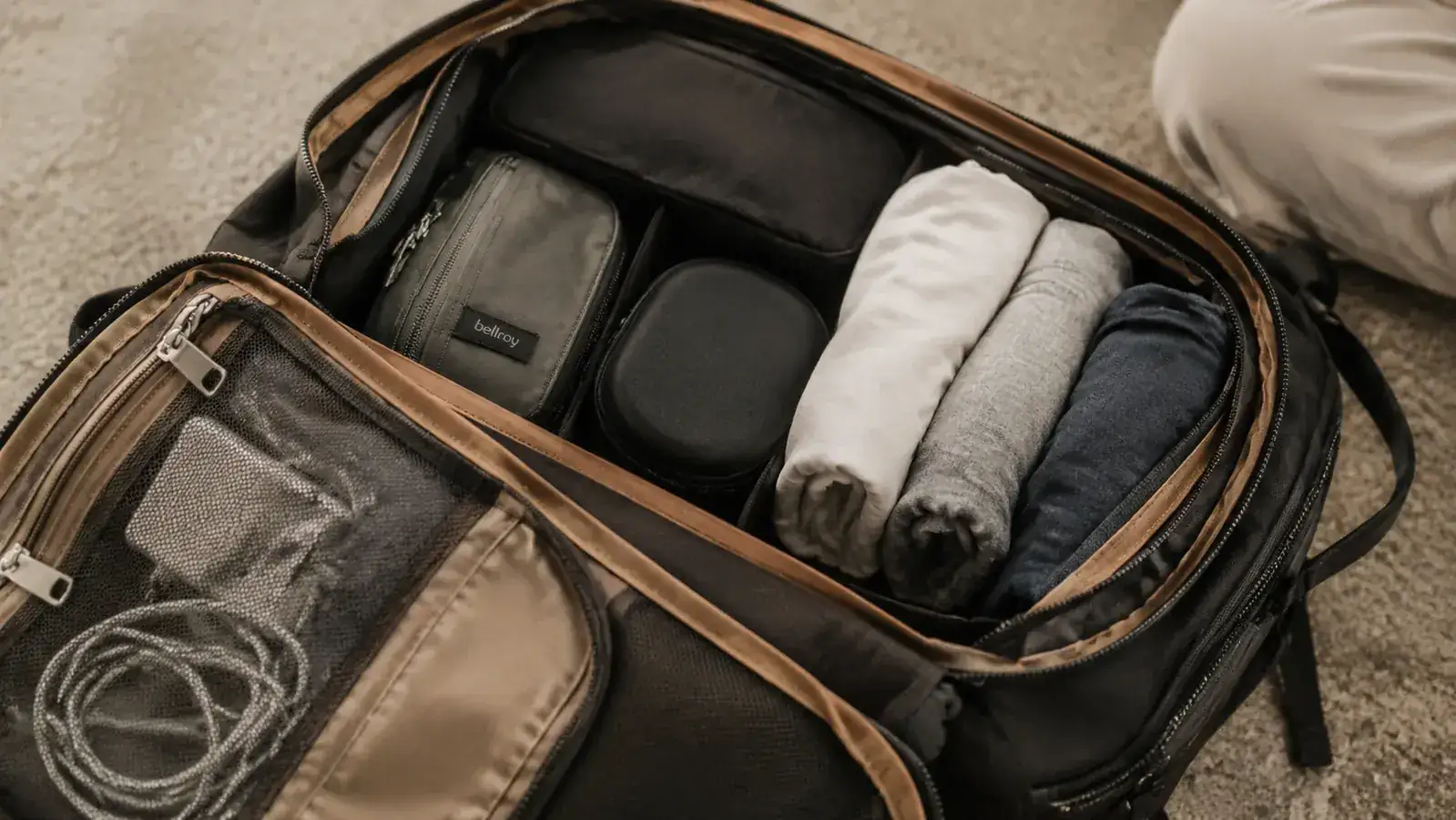
The coofay's main compartment holds this list comfortably using the ranger roll technique rather than folding. Ranger rolling, a military technique where you roll the garment tightly from the hem upward, compresses clothes to roughly half their folded volume and keeps them wrinkle-free because there are no fold creases. I can fit three ranger-rolled tops, two rolled pairs of pants, and four rolled underwear into a space roughly the size of a bread loaf. The rest of the main compartment holds my packable jacket stuffed into its own pocket.
Step 3: Use the Front Organizer Pocket as Your Daily Carry Wallet
The coofay has a front zip pocket with a built-in organizer: a key clip, card slots, and several small mesh pockets. I treat this as my airport-to-hotel daily carry station. In it goes: my passport (in an RFID sleeve), one credit card and one debit card, a folded cash reserve in local currency, my phone charging cable, a universal adapter, my earbuds case, one pen, and my boarding pass screenshot. Everything I need between bag drop and hotel room is in this pocket.
Why does this matter for packing? Because it keeps your main compartment clean. If your daily-access items are scattered through the main compartment, you end up repacking every time you need your passport. A clean main compartment means you are not digging, which means you are not disrupting the structure of your pack, which means the bag maintains its shape and fits under the seat without bulging awkwardly.
For longer international trips, I pair the coofay's front pocket with a neck wallet for passport storage through customs and high-risk areas. The coofay itself carries everything else. The system is: neck wallet for active travel, coofay front pocket for hotel-to-gate transitions.
The gate agent at FLL measured my coofay twice. Both times it passed. The roller bag behind me cost that traveler $79. Packing right is literally cheaper than packing wrong.
Step 4: Pack Your Toiletries Last and Pack Them Flat
Toiletries are where most personal-item packing attempts collapse. People pack a full-size shampoo because they are used to checking a bag. Then the TSA 3-1-1 rule forces them to repack at security, and a quart-size bag of liquids is surprisingly bulky. The fix: go dry whenever possible and buy on arrival when you cannot.
My personal item toiletry kit: a 3.4 oz refillable bottle of shampoo, a 3.4 oz conditioner, a solid deodorant stick (no liquid size restriction), a solid-bar sunscreen, a razor, my prescription meds in their original bottles, and a small first-aid pouch. Everything fits in a single quart-size Ziploc that lays flat against the coofay's back panel, inside the main compartment. Flat is the key word. Toiletries packed in a round cosmetics bag become a hard sphere that eats up cubic inches and makes the bag lump. Flat means they conform to the bag's shape.
If you use a skincare routine that requires more than two products: either decant them into 0.5 oz sample bottles or accept that you will buy travel sizes at a drugstore on arrival. A face wash and moisturizer in travel-size format weigh almost nothing and cost $4 at CVS. Packing them instead of bringing full-size tubes frees up roughly 40% of your toiletry volume.
Step 5: Load the Bag in the Right Order
Packing order matters for two reasons: balance and access. A top-heavy bag shifts when you lift it onto the overhead bin sizer, potentially failing on depth. A bottom-heavy bag is uncomfortable to carry through the airport. Here is the order I use with the coofay, starting with the back panel and working forward.
Back panel first: laptop or tablet in the dedicated sleeve, padded and flat. This is closest to your back when worn and acts as a structural spine. Behind it, if your laptop is thin, you can slip a travel journal or a paperback. Middle section of main compartment: ranger-rolled clothes standing on end, not layered flat. Standing rolls let you see everything at once and pull one item without disturbing the others. It is the same principle as KonMari folding for a suitcase, adapted for a backpack. Front section of main compartment: toiletry flat-pack and packable jacket stuffed into its own pocket. Front exterior pocket: daily carry items as described in Step 3.
When loaded this way, the coofay's 22-liter main compartment holds a four-night kit with room to spare for a lightweight pair of sneakers (if you are wearing boots on the plane) or a packable tote for grocery runs at your destination. The bag ends up weighing between 12 and 15 pounds fully packed, which is comfortable on one shoulder through a terminal or worn as a backpack on a longer connection.
What Else Helps
A few tools that make personal-item-only travel more comfortable without adding meaningful weight. A packing cube set, even a small two-cube subset from an 8-set kit, helps maintain the standing-roll organization through multiple unpacks and repacks during a trip. Without them, the ranger rolls tend to loosen after the second day and you lose the visual-inventory benefit. BAGAIL's compression cubes are thin-walled enough to fit inside the coofay's main compartment without adding structural rigidity that would make the bag harder to compress for a sizer test.
A lightweight packable tote, folded down to the size of a wallet, lives in the coofay's front pocket and handles anything you acquire on the trip: a market purchase, a bottle of wine you refuse to leave behind, souvenirs. This is cheaper and less annoying than buying a checked bag at the airport because you overbought at a market. Keep one in the bag permanently.
For trips longer than five nights, the honest answer is that a personal-item-only system requires doing laundry at least once. Most hotels will press a shirt for a few dollars. Many Airbnbs have a washer. Budget travelers can find laundromats in any city in under five minutes on Google Maps. Doing one load of laundry is significantly cheaper and less stressful than paying for a checked bag on both legs of a round trip.
The One Thing People Always Ask Me About
Shoes. Every time I tell someone I pack four nights into a personal item, they ask about shoes. The answer is: you wear your biggest shoes on the plane. If your trip involves one setting and one shoe type, you are done. If you need dress shoes for a dinner, they are the one extra item I allow, and they go on top of the ranger rolls in the main compartment with a shoe bag around them to protect the clothes. Anything beyond that is a checked-bag trip, and that is fine. The goal is not purity. The goal is knowing exactly which trips you can do carry-on-only and executing that system correctly.
The coofay handles the structural side of this system well. It is not a premium bag in the sense that it has leather pulls or aerospace-grade zippers. It is a well-designed functional bag at a price point that means you do not panic when the overhead bin door clips a corner. It passes the sizer tests that matter, it organizes the way a personal item should organize, and it has survived a year of my use without a zipper failure or seam split. For a bag that costs less than a checked bag fee on a round trip, it earns its place in the system.
The coofay fits under the seat, passes the size test, and costs less than one gate-check fee. That is the whole math.
Airline-approved dimensions, waterproof shell, organized compartments. 4.6 stars from over 10,000 travelers who figured out the personal-item system.
Amazon Check Today's Price on Amazon →